Beech-Maple Mesic Forest
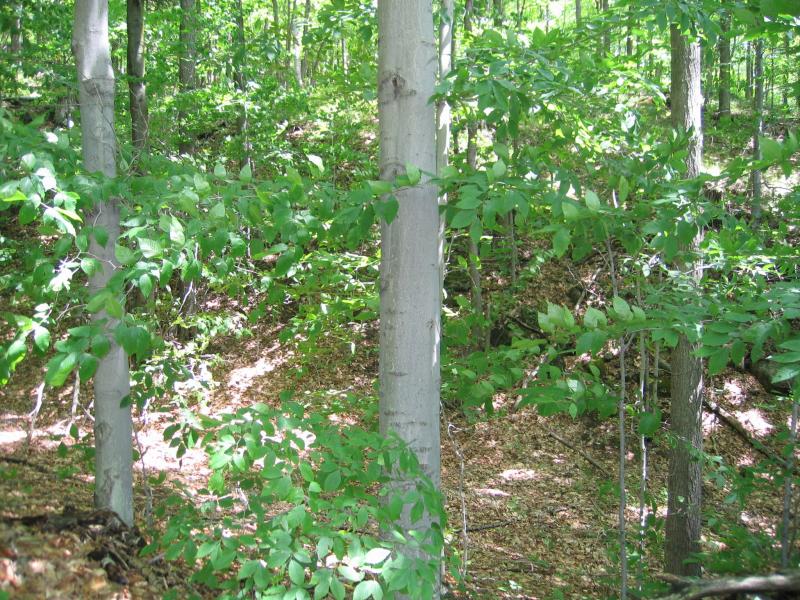
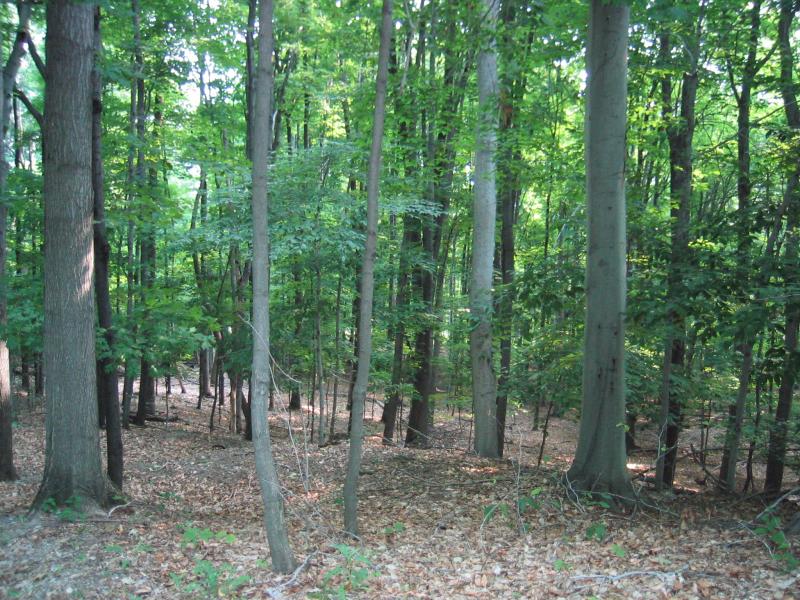
Beech-maple mesic forest on the midslope of The Pinnacle in Washington County, NY
Gregory J. Edinger
- System
- Terrestrial
- Subsystem
- Forested Uplands
- State Protection
- Not Listed
Not listed or protected by New York State.
- Federal Protection
- Not Listed
- State Conservation Status Rank
- S3?
Vulnerable in New York (most likely) - Conservation status is uncertain, but most likely vulnerable to disappearing from New York due to rarity or other factors (but not currently imperiled); typically 21 to 80 populations or locations in New York, few individuals, restricted range, few remaining acres (or miles of stream), and/or recent and widespread declines. More information is needed to assign a firm conservation status.
- Global Conservation Status Rank
- G4
Apparently Secure globally - Uncommon in the world but not rare; usually widespread, but may be rare in some parts of its range; possibly some cause for long-term concern due to declines or other factors.
Summary
Did you know?
American witch-hazel (Hamamelis virginiana) is a common shrub found in beech-maple mesic forests. It was used by native peoples for thousands of years and later by American settlers. Although witch hazel is not as popular as it was in the 1900s, it is still used to prevent infection from cuts, soothe insect bites and sunburn, relieve pain and swelling, reduce acne, tone skin, and as an aftershave.
State Ranking Justification
There are several hundred to a few thousand occurrences statewide. Some documented occurrences have good viability and many are protected on public land or private conservation land. This community has statewide distribution and includes several very large, high quality, old-growth examples. The current trend of this community is probably declining due to moderate and imminent threats related to beech bark disease and development pressure.
Short-term Trends
The number and acreage of beech-maple mesic forests in New York have declined moderately in recent decades as a result of logging, agriculture, and other development.
Long-term Trends
The number and acreage of beech-maple mesic forests in New York have probably declined substantially from historical numbers likely correlated with past logging, agiculture, and other development.
Conservation and Management
Threats
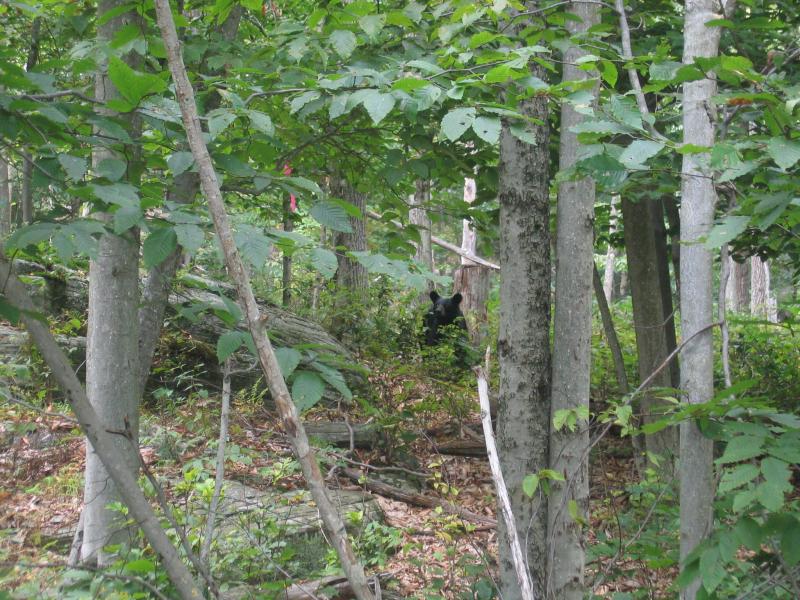
Threats to forests in general include changes in land use (e.g., clearing for development), forest fragmentation (e.g., roads), and invasive species (e.g., insects, diseases, and plants). Other threats may include over-browsing by deer, and air pollution (e.g., ozone and acidic deposition). When occurring in expansive forests, the largest threat to the integrity of beech-maple mesic forests are activities that fragment the forest into smaller pieces. These activities, such as road building and other development, restrict the movement of species and seeds throughout the entire forest, an effect that often results in loss of those species that require larger blocks of habitat (e.g., black bear, bobcat, certain bird species). Additionally, fragmented forests provide decreased benefits to neighboring societies from services these societies often substantially depend on (e.g., clean water, mitigation of floods and droughts, pollination in agricultural fields, and pest control) (Daily et al. 1997). American beech (Fagus grandifolia) trees in this community are threatened by the following diseases: 1) Beech Bark Disease causes significant mortality and defect in American beech. The disease results when bark, attacked and altered by the beech scale (Cryptococcus fagisuga), is invaded and killed by fungi, primarily Nectria coccinea var. faginata and sometimes N. galligena (Houston and O'Brien 1983). This disease is common across New York State (NYS DEC); 2) Beech Leaf Disease was first discovered in 2012 from northeastern Ohio (Ewing et al. 2019). The disease was first observed in New York in 2018 in Chautauqua County and was found in Suffolk and Nassau counties in 2019 (NYS DEC). It has since spread throughout western, central, and southern NY (NYS DEC). The foliar nematode Litylenchus crenatae ssp. mcannii is responsible for beech leaf disease and is believed to be non-native in North America (Carta et al. 2020, Reed et al. 2020). Beech leaf disease can kill beech trees of all ages though younger trees appear to die more quickly (NYS DEC).
Conservation Strategies and Management Practices
Management should focus on activities that help maintain regeneration of the species associated with this community. Develop a plan to eliminate or control beech bark disease. Deer have been shown to have negative effects on forest understories (Miller et al. 1992, Augustine & French 1998, Knight 2003) and management efforts should strive to ensure that regenerating trees and shrubs are not so heavily browsed that they cannot replace overstory trees. Avoid cutting old-growth examples and encourage selective logging in areas that are under active forestry.
Development and Mitigation Considerations
Strive to minimize fragmentation of large forest blocks by focusing development on forest edges, minimizing the width of roads and road corridors extending into forests, and designing cluster developments that minimize the spatial extent of the development. Development projects with the least impact on large forests and all the plants and animals living within these forests are those built on brownfields or other previously developed land. These projects have the added benefit of matching sustainable development practices (for example, see: The President's Council on Sustainable Development 1999 final report, US Green Building Council's Leadership in Energy and Environmental Design certification process at http://www.usgbc.org/).
Inventory Needs
Inventory any remaining large and/or old-growth examples across the state.
Research Needs
Critically compare this community to maple-basswood rich mesic forest and confirm that occurrences of each are properly classified. Regularly assess the presence and degree of impact that beech bark disease has on this forest community.
Rare Species
- Aconitum noveboracense (Northern Monkshood) (guide)
- Agastache nepetoides (Yellow Giant Hyssop) (guide)
- Agrimonia rostellata (Woodland Agrimony) (guide)
- Andersonglossum boreale (Northern Wild Comfrey) (guide)
- Aplectrum hyemale (Puttyroot) (guide)
- Asimina triloba (Pawpaw) (guide)
- Botrychium oneidense (Blunt-lobed Grape Fern) (guide)
- Carex arcta (Northern Clustered Sedge) (guide)
- Carex jamesii (James' Sedge) (guide)
- Carya laciniosa (Big Shellbark Hickory) (guide)
- Cirriphyllum piliferum (Hair-pointed Moss) (guide)
- Corallorhiza striata var. striata (Striped Coralroot) (guide)
- Criorhina nigriventris (Bare-cheeked Bumblefly) (guide)
- Crotalus horridus (Timber Rattlesnake) (guide)
- Cystopteris protrusa (Lowland Fragile Fern) (guide)
- Frasera caroliniensis (Green Gentian) (guide)
- Galium concinnum (Shining Bedstraw) (guide)
- Geothlypis formosa (Kentucky Warbler) (guide)
- Geum virginianum (Cream-colored Avens) (guide)
- Haliaeetus leucocephalus (Bald Eagle) (guide)
- Lasiurus borealis (Eastern Red Bat) (guide)
- Lindbergia brachyptera (Papillose Fine-branch Moss) (guide)
- Myotis leibii (Eastern Small-footed Myotis) (guide)
- Myotis lucifugus (Little Brown Bat) (guide)
- Myotis septentrionalis (Northern Long-eared Bat) (guide)
- Myotis sodalis (Indiana Bat) (guide)
- Perimyotis subflavus (Tri-colored Bat) (guide)
- Pieris virginiensis (West Virginia White) (guide)
- Platanthera hookeri (Hooker's Orchid) (guide)
- Poa sylvestris (Forest Blue Grass) (guide)
- Pseudotaxiphyllum distichaceum (Two-ranked moss) (guide)
- Pterospora andromedea (Pine Drops) (guide)
- Setophaga cerulea (Cerulean Warbler) (guide)
- Sylvilagus transitionalis (New England Cottontail) (guide)
- Triphora trianthophora (Nodding Pogonia) (guide)
Range
New York State Distribution
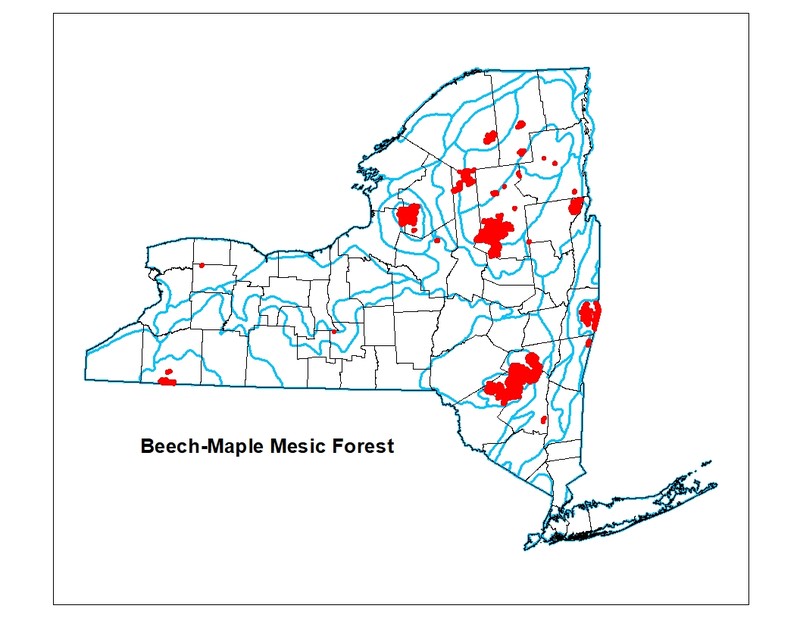
This community is widespread throughout Upstate New York. It is probably represented by different ecoregional variants. It forms the matrix forest of the Northern Appalachian Ecoregion in the Adirondacks and Tug Hill. Beech-maple mesic forest is also present in the Lower New England, the Great Lakes, and the High Allegheny Plateau ecoregions. This community is absent from the North Atlantic Coast Ecoregion where it is replaced by the similar coastal oak-beech forest.
Global Distribution
This somewhat broadly-defined community is probably widespread throughout the northeastern U.S. The range is estimated to span north to southern Canada, west to Minnesota, southwest to Indiana and Tennessee, southeast to Virginia, and northeast to Nova Scotia.
Best Places to See
- Pixley Falls State Park (Oneida County)
- Catskill Park (Ulster County)
- Cherry Plain State Park (Rensselaer County)
- Grafton Lakes State Park (Rensselaer County)
- Tug Hill Wildlife Management Area (Oswego County)
- West Canada Lakes Wilderness Area (Hamilton, Herkimer Counties)
- Adirondack Park (Hamilton County)
Identification Comments
General Description
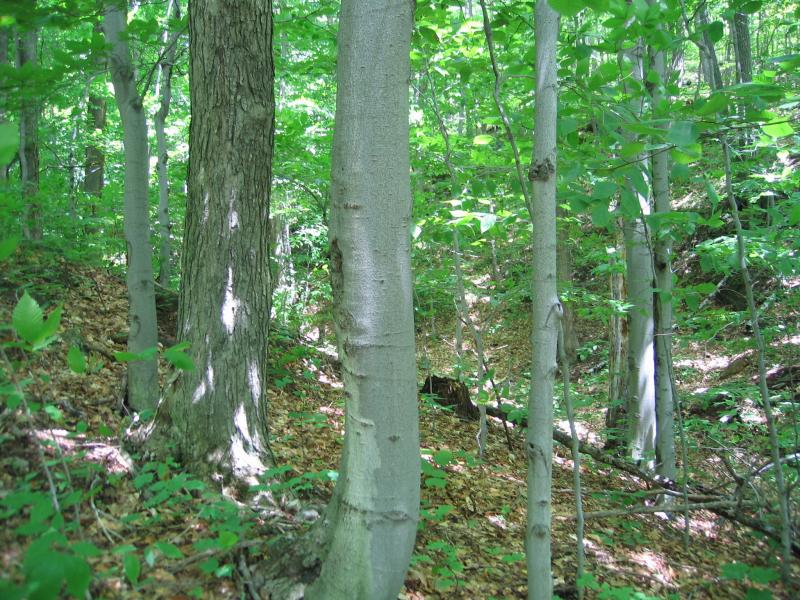
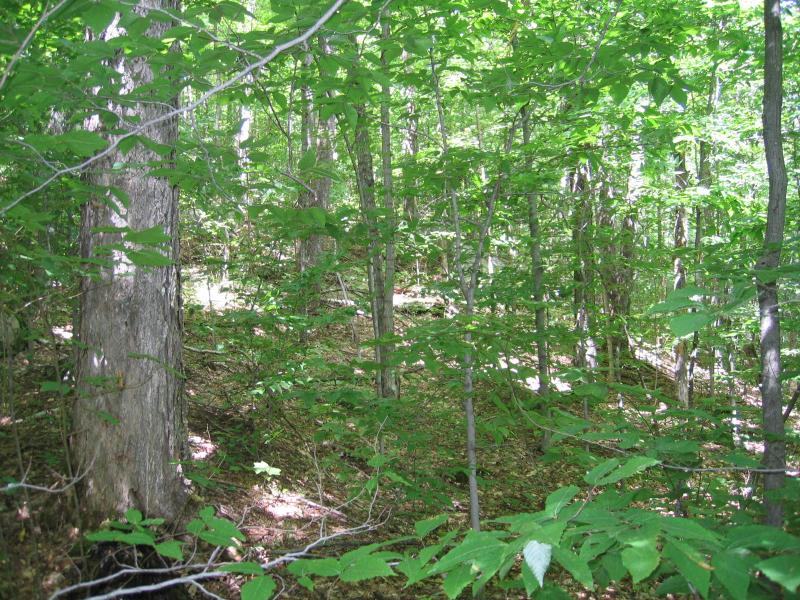
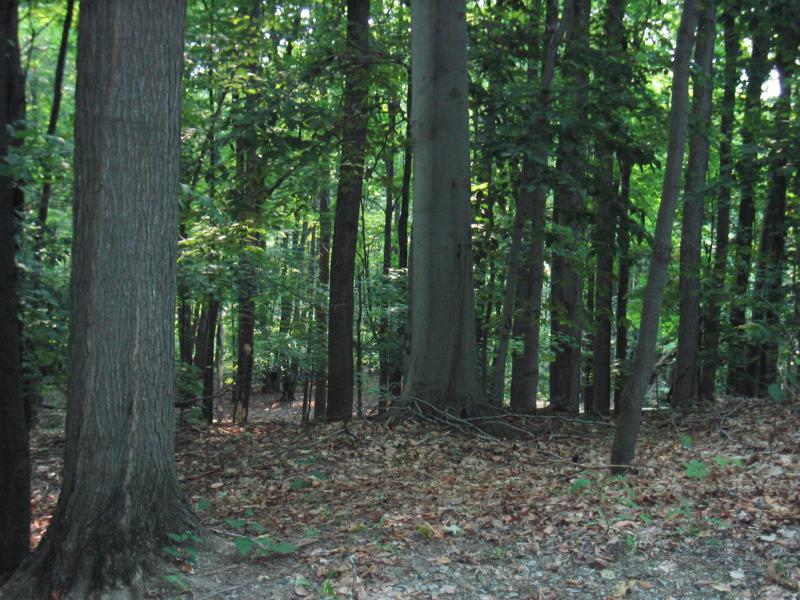
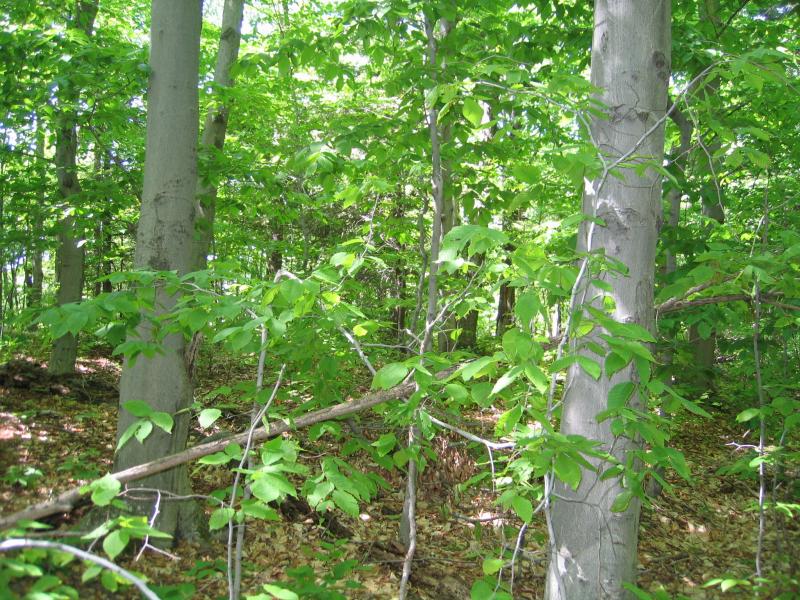
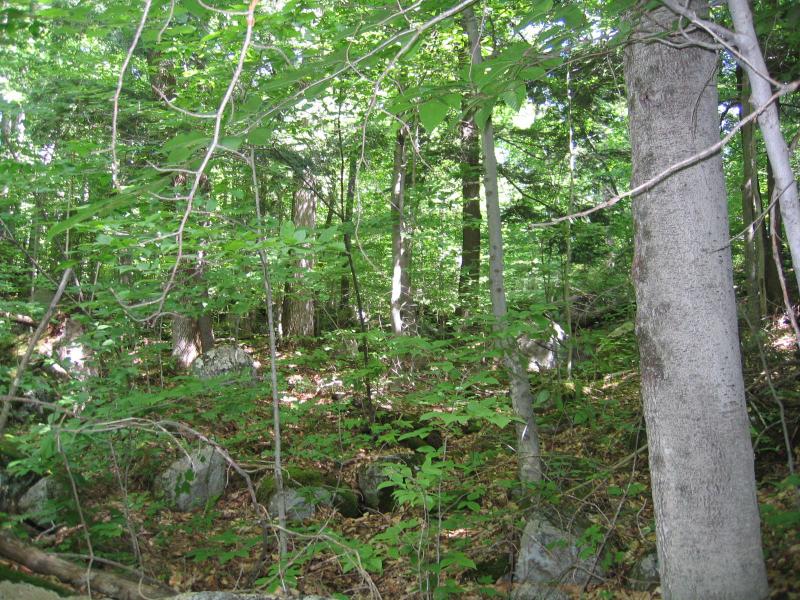
Beech-maple mesic forest communities are closed-canopy hardwood forests with codominating sugar maple (Acer saccharum) and American beech (Fagus grandifolia). This is a broadly defined community type with several regional and edaphic variants. These forests occur on moist, well drained, usually acid soils. There are many spring ephemerals that bloom before the canopy trees leaf out. Hemlock (Tsuga canadensis) may be present at a low density. In the Adirondacks a few red spruce (Picea rubens) may also be present.
Characters Most Useful for Identification
The codominance of American beech and sugar maple and a variety of herbaceous species, including a good display of spring ephermals, identify this community. Typically there is also an abundance of tree seedlings, especially of sugar maple; beech and sugar maple saplings are often the most abundant small trees in the understory, along with shrubs such as American witch-hazel (Hamamelis virginiana) and hobblebush (Viburnum lantanoides).
Elevation Range
Known examples of this community have been found at elevations between 320 feet and 4,186 feet.
Best Time to See
Because the key to distinguishing a beech-maple mesic forest from related types is its vascular plant composition and diversity, it is easiest to identify the community during the growing season, from late May through summer. Striking seasonal leaf color can be enjoyed in the fall.
Beech-Maple Mesic Forest Images
Gregory J. Edinger
Gregory J. Edinger
Gregory J. Edinger
Gregory J. Edinger
Gregory J. Edinger
Gregory J. Edinger
Gregory J. Edinger
Gregory J. Edinger
Classification
International Vegetation Classification Associations
This New York natural community encompasses all or part of the concept of the following International Vegetation Classification (IVC) natural community associations. These are often described at finer resolution than New York's natural communities. The IVC is developed and maintained by NatureServe.
- Sugar Maple - Yellow Birch - American Beech / Hobblebush Forest (CEGL006631)
- Sugar Maple - Yellow Birch - Black Cherry Forest (CEGL006045)
- Sugar Maple - American Beech - White Ash / Jack-in-the-Pulpit Forest (CEGL006632)
- Sugar Maple - (White Ash) / Jack-in-the-Pulpit Forest (CEGL006211)
- American Beech - Sugar Maple Glaciated Midwest Forest (CEGL005013)
- Northern Red Oak - Sugar Maple - American Beech / Mapleleaf Viburnum Forest (CEGL006633)
- Northern Red Oak - Sugar Maple / Mapleleaf Viburnum - Northern Spicebush Forest (CEGL006635)
NatureServe Ecological Systems
This New York natural community falls into the following ecological system(s). Ecological systems are often described at a coarser resolution than New York's natural communities and tend to represent clusters of associations found in similar environments. The ecological systems project is developed and maintained by NatureServe.
- Laurentian-Acadian Northern Hardwood Forest (CES201.564)
- North-Central Interior Beech-Maple Forest (CES202.693)
Characteristic Species
-
Trees > 5m
- Acer rubrum var. rubrum (common red maple)
- Acer saccharum (sugar maple)
- Betula alleghaniensis (yellow birch)
- Betula lenta (black birch)
- Fagus grandifolia (American beech)
- Fraxinus americana (white ash)
- Ostrya virginiana (hop hornbeam, ironwood)
- Picea rubens (red spruce)
- Prunus serotina var. serotina (wild black cherry)
- Quercus rubra (northern red oak)
- Tsuga canadensis (eastern hemlock)
-
Shrubs 2 - 5m
- Acer pensylvanicum (striped maple)
- Carpinus caroliniana ssp. virginiana (musclewood, ironwood, American hornbeam)
- Cornus alternifolia (pagoda dogwood, alternate-leaved dogwood)
- Hamamelis virginiana (witch-hazel)
- Viburnum lantanoides (hobblebush)
-
Shrubs < 2m
- Viburnum acerifolium (maple-leaved viburnum)
-
Herbs
- Ageratina altissima var. altissima (common white snakeroot)
- Aralia nudicaulis (wild sarsaparilla)
- Arisaema triphyllum ssp. triphyllum (common jack-in-the-pulpit)
- Brachyelytrum erectum (southern shorthusk)
- Carex pensylvanica (Pennsylvania sedge)
- Dennstaedtia punctilobula (hay-scented fern)
- Dryopteris carthusiana (spinulose wood fern)
- Dryopteris intermedia (evergreen wood fern, fancy wood fern, common wood fern)
- Dryopteris marginalis (marginal wood fern)
- Epifagus virginiana (beech-drops)
- Erythronium americanum ssp. americanum (yellow trout-lily)
- Eurybia divaricata (white wood-aster)
- Huperzia lucidula (shining firmoss)
- Lysimachia borealis (starflower)
- Maianthemum canadense (Canada mayflower)
- Maianthemum racemosum ssp. racemosum (false Solomon's-seal)
- Medeola virginiana (Indian cucumber-root)
- Mitchella repens (partridge-berry)
- Oclemena acuminata (whorled wood-aster)
- Oxalis montana (northern wood sorrel)
- Podophyllum peltatum (may-apple)
- Polygonatum biflorum var. biflorum (small Solomon's-seal)
- Polygonatum pubescens (hairy Solomon's-seal)
- Polystichum acrostichoides (Christmas fern)
- Solidago caesia var. caesia (blue-stemmed goldenrod, wreath goldenrod)
- Tiarella cordifolia (foamflower)
- Trillium erectum (purple trillium, stinking Benjamin)
- Trillium undulatum (painted trillium)
- Uvularia sessilifolia (wild-oats, sessile-leaved bellwort)
- Viola spp.
Similar Ecological Communities
- Coastal oak-beech forest
(guide)
Beech-maple mesic forests occur on moister soils than coastal oak-beech forests and have a higher diversity of canopy, shrub, and herbaceous species. Beech-maple mesic forests occur throughout the state and have characteristic regional variants, whereas coastal oak-beech forests occur only on the Atlantic Coastal Plain.
- Maple-basswood rich mesic forest
(guide)
Maple-basswood rich mesic forests have a higher diversity of rich-soil herbs, including a variety of fern species and many spring ephemerals. Beech-maple mesic forests have more acid-tolerant herbs and ferns, and a slightly lower diversity.
- Maritime beech forest
(guide)
Maritime beech forest is a hardwood forest with American beech (Fagus grandifolia) dominant that usually occurs on north-facing exposed bluffs and the back portions of rolling dunes in well-drained fine sands. Wind and salt spray cause the beech trees to be stunted (average height 4 m to 15 m) and multiple-stemmed with contorted branches, especially on the exposed bluffs.
- Rich mesophytic forest
(guide)
Rich mesophytic forests occur on the Allegheny Plateau of southern New York and have a richer herb component, including such herbs as Canada waterleaf (Hydrophyllum canadense), running strawberry bush (Euonymus obovata), yellow mandarin (Disporum lanuginosum), and black bugbane (Cimicifuga racemosa).
Vegetation
Percent cover
This figure helps visualize the structure and "look" or "feel" of a typical Beech-Maple Mesic Forest. Each bar represents the amount of "coverage" for all the species growing at that height. Because layers overlap (shrubs may grow under trees, for example), the shaded regions can add up to more than 100%.
Additional Resources
References
Augustine, A.J. and L.E. French. 1998. Effects of white-tailed deer on populations of an understory forb in fragmented deciduous forests. Conservation Biology 12:995-1004.
Carta L.K, Z.A. Handoo, L. Shiguang, M. Kantor, G. Bauchan, D. McCann, C.K. Gabriel, Q. Yu, S. Reed, J. Koch, D. Martin, and D.J. Burke. 2020. Beech leaf disease symptoms caused by newly recognized nematode subspecies Litylenchus crenatae mccannii (Anguinata) described from Fagus grandifolia in North America. Forest Pathology, 50: e12580. https://doi.org/10.1111/efp.12580
Daily, G.C., S. Alexander, P.R. Ehrlich, L. Goulder, J. Lubchenco, P. Matson, H.A. Mooney, S. Postel, S.H. Schneider, D. Tilman, and G.M. Woodwell. 1997. Ecosystem Services: benefits supplied to human societies by natural ecosystems. Issues In Ecology 2:1-16.
Edinger, G. J., D. J. Evans, S. Gebauer, T. G. Howard, D. M. Hunt, and A. M. Olivero (editors). 2014. Ecological Communities of New York State. Second Edition. A revised and expanded edition of Carol Reschke’s Ecological Communities of New York State. New York Natural Heritage Program, New York State Department of Environmental Conservation, Albany, NY. https://www.nynhp.org/ecological-communities/
Edinger, Gregory J., D.J. Evans, Shane Gebauer, Timothy G. Howard, David M. Hunt, and Adele M. Olivero (editors). 2002. Ecological Communities of New York State. Second Edition. A revised and expanded edition of Carol Reschke's Ecological Communities of New York State. (Draft for review). New York Natural Heritage Program, New York State Department of Environmental Conservation. Albany, NY. 136 pp.
Ewing C.J., C.E. Hausman, J. Pogacnik, J. Slot, and P. Bonello. 2019. Beech leaf disease: An emerging forest epidemic. Forest Pathology 49: e12488. https://doi.org/10.1111/efp.12488
Eyre, F.H., ed. 1980. Forest cover types of the United States and Canada. Society of American Foresters, Washington, D.C.
Gordon, Robert B. 1940. The primeval forest types of southwestern New York. New York State Museum Bulletin 321:1-102.
Hagan, J.M. and A.A. Whitman. 2004. Late-successional Forest:A disappearing age class and implications for biodiversity. Manomet Center for Conservation Sciences. 4 pp.
Heimburger, C.C. 1934. Forest-type studies in the Adirondack Region. Cornell University Experiment Station Memoir 165, Ithaca, New York.
Holmes, R. T., T. W. Sherry, and F. W. Sturges. 1986. Bird community dynamics in a temperate deciduous forest: long-term trends at Hubbard Brook. Ecological Monographs 56:201-220.
Houston, D.R. and J. O'Brien. 1983. Beech bark disease. Forest Insect and Disease Leaflet 75. U.S. Department of Agriculture, Forest Service, Washington, D.C.
Knight, T.M. 2003. Effects of herbivory and its timing across populations of Trillium grandiflorum (Liliaceae). American Journal of Botany 90:1207-1214.
Leopold, Donald J., Carol Reschke, and D.S. Smith. 1988. Old-growth forests of the Adirondack Park, New York. Natural Areas Journal 8: 166-189.
McIntosh, R.P. 1972. Forests of the Catskill Mountains, New York. Ecol. Monogr. 42:143-161.
Miller, S.G., S.P. Bratton, and J. Hadidian. 1992. Impacts of white-tailed deer on endangered and threatened vascular plants. Natural Areas Journal 12:67-74.
New York Natural Heritage Program. 2024. New York Natural Heritage Program Databases. Albany, NY.
Reed, S.E., S. Greifenhagen, Q. Yu, A. Hoke, D.J. Burke, L.K. Carta, Z.A. Handoo, M.R. Kantor, and J. Koch. 2020. Foliar nematode, Litylenchus crenatae ssp. mccannii, population dynamics in leaves and buds of beech leaf disease-affected trees in Canada and the US. Forest Pathology, 50: e12599. https://doi.org/10.1111/efp.12599
Reschke, Carol. 1990. Ecological communities of New York State. New York Natural Heritage Program, New York State Department of Environmental Conservation. Latham, NY. 96 pp. plus xi.
Shanks, R.E. 1966. An ecological survey of the vegetation of Monroe County, New York. Proc. Rochester Academy Sci. 11:108-252.
The President's Council on Sustainable Development. 1999. Towards a Sustainable America: Advancing Prosperity, Opportunity, and a Healthy environment for the 21st Century. Washington, DC. 97 pp. plus appendices.
Links
About This Guide
Information for this guide was last updated on: January 23, 2024
Please cite this page as:
New York Natural Heritage Program. 2024.
Online Conservation Guide for
Beech-maple mesic forest.
Available from: https://guides.nynhp.org/beech-maple-mesic-forest/.
Accessed April 19, 2024.