Oak-Tulip Tree Forest
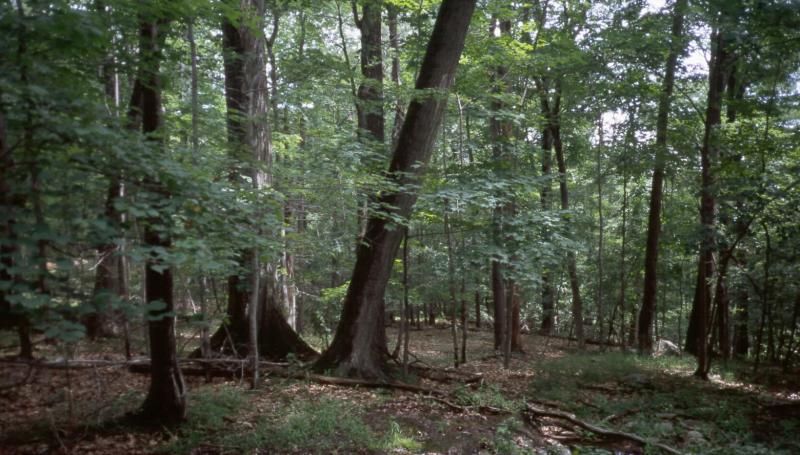
Oak-tulip tree forest
D.J. Evans
- System
- Terrestrial
- Subsystem
- Forested Uplands
- State Protection
- Not Listed
Not listed or protected by New York State.
- Federal Protection
- Not Listed
- State Conservation Status Rank
- S1S2
Critically Imperiled or Imperiled in New York - Especially or very vulnerable to disappearing from New York due to rarity or other factors; typically 20 or fewer populations or locations in New York, very few individuals, very restricted range, few remaining acres (or miles of stream), and/or steep declines. More information is needed to assign either S1 or S2.
- Global Conservation Status Rank
- G4
Apparently Secure globally - Uncommon in the world but not rare; usually widespread, but may be rare in some parts of its range; possibly some cause for long-term concern due to declines or other factors.
Summary
Did you know?
There are only two species of Liriodendron in the world. Both are in the magnolia family and have flowers that resemble tulips. One is characteristic of oak-tulip tree forests in the eastern U.S (Liriodendron tulipifera), the other is native to China (Liriodendron chinense). In these eastern U.S. forests, tulip trees and white pine are the largest trees. They can grow rather tall (60 to 90 feet and sometimes up to 150 feet) and very rapidly. Due to this quality, Native Americans made dugout canoes from tulip tree trunks.
State Ranking Justification
There are less than one hundred occurrences statewide. A few documented occurrences have good viability and several are protected on public land or private conservation land. This community is somewhat limited to the Lower Hudson Valley and western Long Island, and most examples are fragmented and disturbed. The current trend of this community is probably declining thoughout its range in NY. Oak-tulip tree forests are threatened by several invasive plant species, insect pests, over-browsing by deer, and development pressure. This community has declined substantially from historical numbers likely correlated with past logging, agriculture, and other development.
Short-term Trends
The acreage of oak-tulip tree forests in New York have probably declined moderately in recent decades as a result of logging, agriculture, and other development. The number of oak-tulip tree forests may have increased slightly from historical numbers as formerly large matrix examples were fragmented by development into numerous large and small patches.
Long-term Trends
The acreage of oak-tulip tree forests in New York have probably declined substantially from historical numbers likely correlated with past logging, agiculture, and other development. The number of oak-tulip tree forests may have increased substantially from historical numbers as formerly large matrix examples were fragmented by development into numerous large and small patches.
Conservation and Management
Threats
Threats to forests in general include changes in land use (e.g., clearing for development), forest fragmentation (e.g., roads), and invasive species (e.g., insects, diseases, and plants). Other threats may include over-browsing by deer. When occurring in expansive forests, the largest threat to the integrity of oak-tulip tree forests are activities that fragment the forest into smaller pieces. These activities, such as road building and other development, restrict the movement of species and seeds throughout the entire forest, an effect that often results in loss of those species that require larger blocks of habitat (e.g., black bear, bobcat, certain bird species). Additionally, fragmented forests provide decreased benefits to neighboring societies from services these societies often substantially depend on (e.g., clean water, mitigation of floods and droughts, pollination in agricultural fields, and pest control) (Daily et al. 1997). The primary threat to oak-tulip tree forests is the introduction and spread of invasive species. About three-quarters of the currently documented occurrences of oak-tulip tree forest have one or more of the following invasive plants: garlic mustard (Alliaria petiolata), Asiatic bittersweet (Celastrus orbiculatus), Japanese honeysuckle (Lonicera japonica), Japanese stiltgrass (Microstegium vimineum), Japanese barberry (Berberis thunbergii), Morrow’s honeysuckle (Lonicera morrowii), Tartarian honeysuckle (Lonicera tatarica) multiflora rose (Rosa multiflora), and Norway maple (Acer platanoides). Excessive deer browsing is a close secondary threat that is likley reducing woody plant regeneration and diminishing herb diversity of oak-tulip tree forests. These forests are threatened by development (e.g., residential, agricultural, industrial), either directly within the community or in the surrounding landscape. Other threats include habitat alteration (e.g., roads, excessive logging, mining), and recreational overuse (e.g., hiking trails, trash dumping). The oak trees in oak-tulip tree forests may be threatened by the non-native spongy moth (Lymantria dispar), which is one of North America's most devastating forest pests. The spongy moth is known to feed on the foliage of hundreds of species of plants in North America, but its most common hosts are oaks and aspen. Spongy moth populations are typically eruptive in North America; in any forest stand densities may fluctuate from near 1 egg mass per ha to over 1,000 per ha. When densities reach very high levels, trees may become completely defoliated. Several successive years of defoliation, along with contributions by other biotic and abiotic stress factors, may ultimately result in tree mortality (McManus et al. 1980, Liebold 2003). The emerald ash borer (Agrilus planipennis) is an Asian beetle that infests and kills North American ash trees. All native ash trees are susceptible, including white ash, green ash, and black ash. In New York, emerald ash borer has been found mostly south of the Adirondack Mountains, but in 2017 it was recorded in Franklin and St. Lawrence Counties. Natural communities dominated or co-dominated by ash trees would likely be most impacted by emerald ash borer invasion. American beech (Fagus grandifolia) trees in this community are threatened by the following diseases: 1) Beech Bark Disease causes significant mortality and defect in American beech. The disease results when bark, attacked and altered by the beech scale (Cryptococcus fagisuga), is invaded and killed by fungi, primarily Nectria coccinea var. faginata and sometimes N. galligena (Houston and O'Brien 1983). This disease is common across New York State (NYS DEC); 2) Beech Leaf Disease was first discovered in 2012 from northeastern Ohio (Ewing et al. 2019). The disease was first observed in New York in 2018 in Chautauqua County and was found in Suffolk and Nassau counties in 2019 (NYS DEC). It has since spread throughout western, central, and southern NY (NYS DEC). The foliar nematode Litylenchus crenatae ssp. mcannii is responsible for beech leaf disease and is believed to be non-native in North America (Carta et al. 2020, Reed et al. 2020). Beech leaf disease can kill beech trees of all ages though younger trees appear to die more quickly (NYS DEC).
Conservation Strategies and Management Practices
Management should focus on activities that help maintain regeneration of the species associated with this community. Deer have been shown to have negative effects on forest understories (Miller et al. 1992, Augustine & French 1998, Knight 2003) and management efforts should strive to ensure that regenerating trees and shrubs are not so heavily browsed that they cannot replace overstory trees. Avoid cutting old-growth examples and encourage selective logging in areas that are under active forestry.
Development and Mitigation Considerations
Strive to minimize fragmentation of large forest blocks by focusing development on forest edges, minimizing the width of roads and road corridors extending into forests, and designing cluster developments that minimize the spatial extent of the development. Development projects with the least impact on large forests and all the plants and animals living within these forests are those developments built on brownfields or other previously developed land. These projects have the added benefit of matching sustainable development practices (for example, see: The President's Council on Sustainable Development 1999 final report, US Green Building Council's Leadership in Energy and Environmental Design certification process at http://www.usgbc.org/).
Inventory Needs
Inventory any remaining large and old-growth examples across the state. Survey for occurrences statewide to advance documentation and classification of oak-tulip tree forests. A statewide review of oak-tulip tree forests is desirable. Continue searching for large sites in good condition (A- to AB-ranked).
Research Needs
Regularly assess the presence and degree of impact that spongy moth has on this community. Research composition of oak-tulip tree forests statewide in order to characterize variations. Collect sufficient plot data to support the recognition of several distinct oak-tulip tree forest types based on composition, and by ecoregion.
Rare Species
- Andersonglossum virginianum (Southern Wild Comfrey) (guide)
- Blera pictipes (Painted Wood Fly) (guide)
- Callitriche terrestris (Terrestrial Water Starwort) (guide)
- Carex amphibola (Ambiguous Sedge) (guide)
- Carex nigromarginata (Black-edged Sedge) (guide)
- Carex reznicekii (Reznicek's Sedge) (guide)
- Carex striatula (Lined Sedge) (guide)
- Carphophis amoenus (Eastern Wormsnake) (guide)
- Citheronia regalis (Regal Moth) (guide)
- Crotalus horridus (Timber Rattlesnake) (guide)
- Emydoidea blandingii (Blanding's Turtle) (guide)
- Endodeca serpentaria (Virginia Snakeroot) (guide)
- Geothlypis formosa (Kentucky Warbler) (guide)
- Haliaeetus leucocephalus (Bald Eagle) (guide)
- Hydrastis canadensis (Goldenseal) (guide)
- Jeffersonia diphylla (Twinleaf) (guide)
- Lasiurus borealis (Eastern Red Bat) (guide)
- Myotis lucifugus (Little Brown Bat) (guide)
- Myotis septentrionalis (Northern Long-eared Bat) (guide)
- Neotoma magister (Allegheny Woodrat) (guide)
- Perimyotis subflavus (Tri-colored Bat) (guide)
- Pseudotriton ruber (Red Salamander) (guide)
- Sceloporus undulatus (Fence Lizard) (guide)
- Setophaga cerulea (Cerulean Warbler) (guide)
- Smilax pulverulenta (Powdery Carrion Flower) (guide)
- Tachopteryx thoreyi (Gray Petaltail) (guide)
Range
New York State Distribution
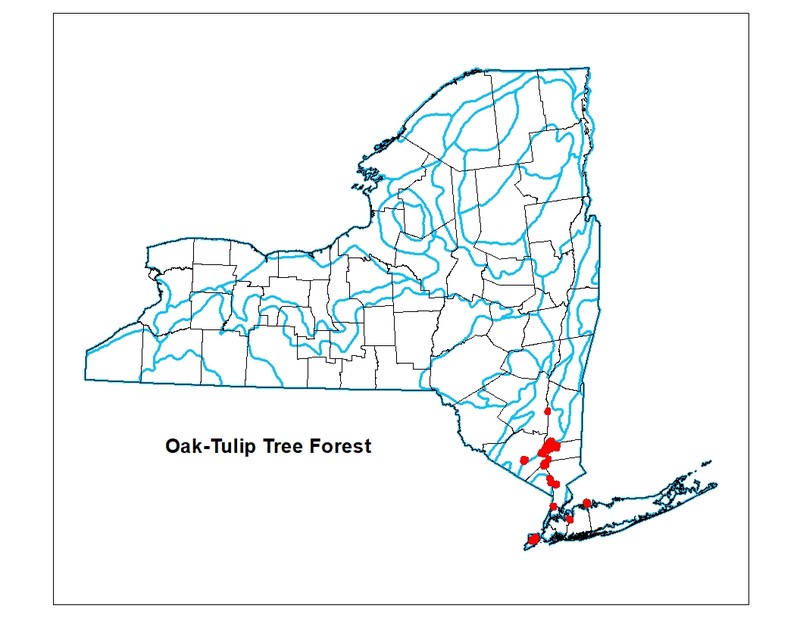
This community is currently known from the lower Hudson Valley primarily within the Hudson Highlands, but also in the Hudson Limestone Valley and western Long Island Coastal Lowland.
Global Distribution
This community is found primarily in the Allegheny Plateau and Appalachian Mountain regions of the United States, with possible extensions east and west of those areas, ranging from southeastern New York and New Jersey, and west to Pennsylvania, West Virginia, and southeast Ohio.
Best Places to See
- Bear Mountain State Park (Orange, Rockland Counties)
- Goose Pond Mountain State Park (Orange County)
- Van Cortlandt Park
- Vanderbilt Mansion National Historic Site
- Latourette Park (Richmond County)
- Caumsett State Park (Suffolk County)
Identification Comments
General Description
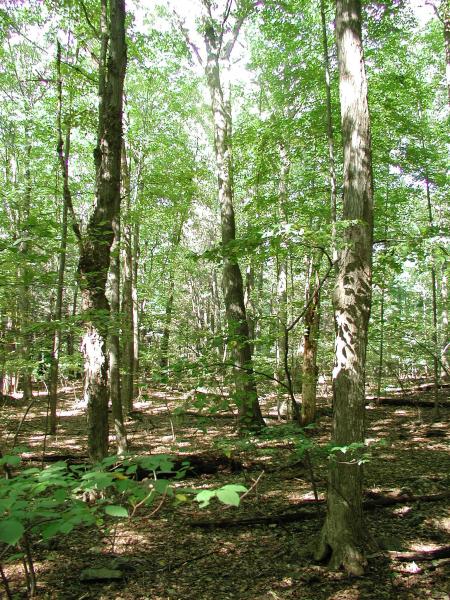
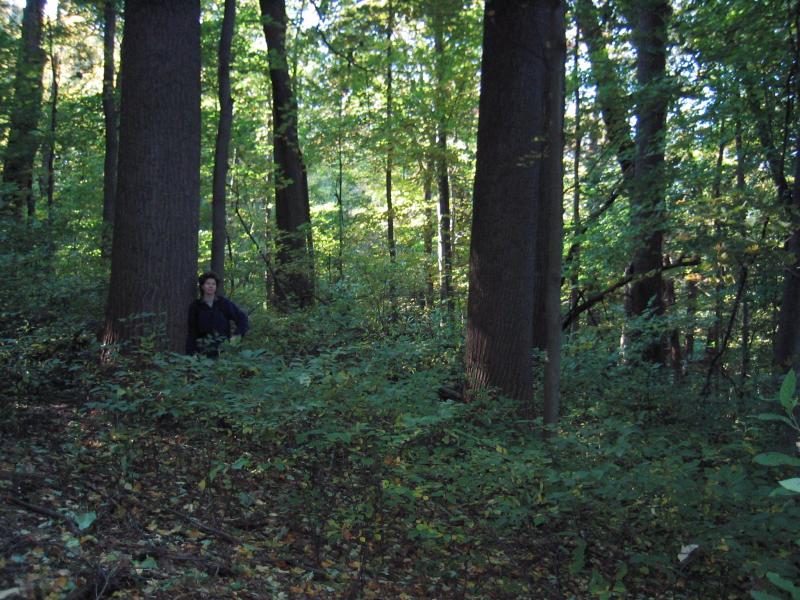
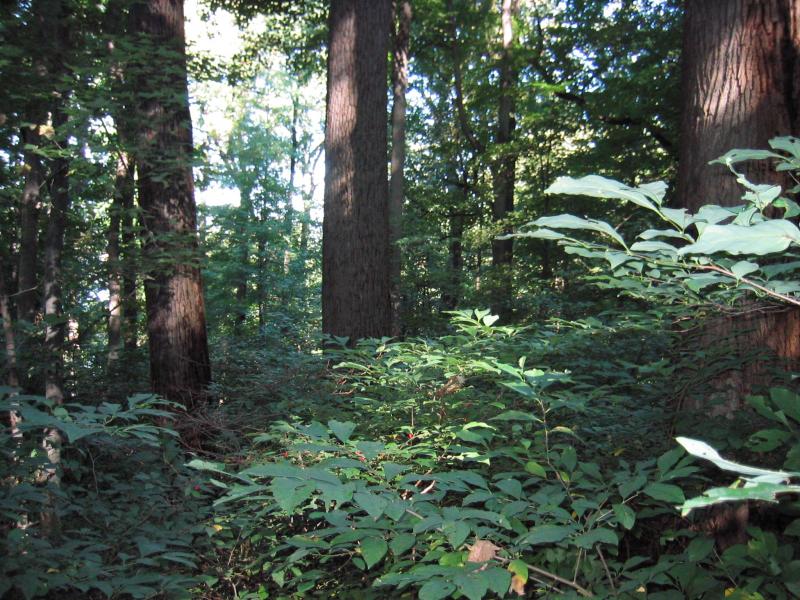
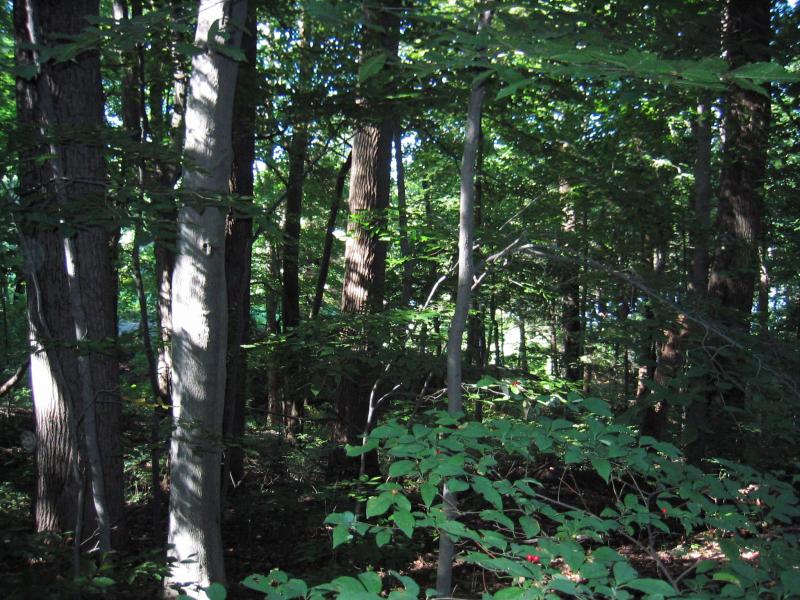
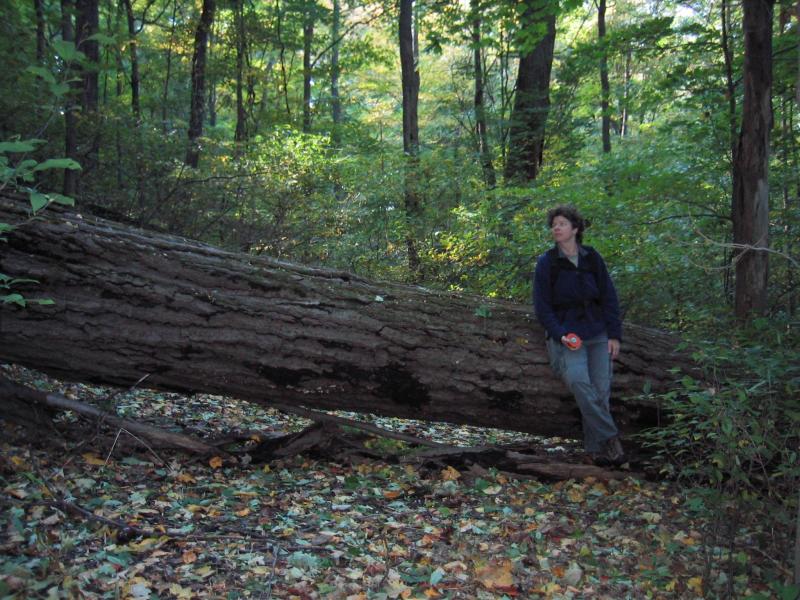
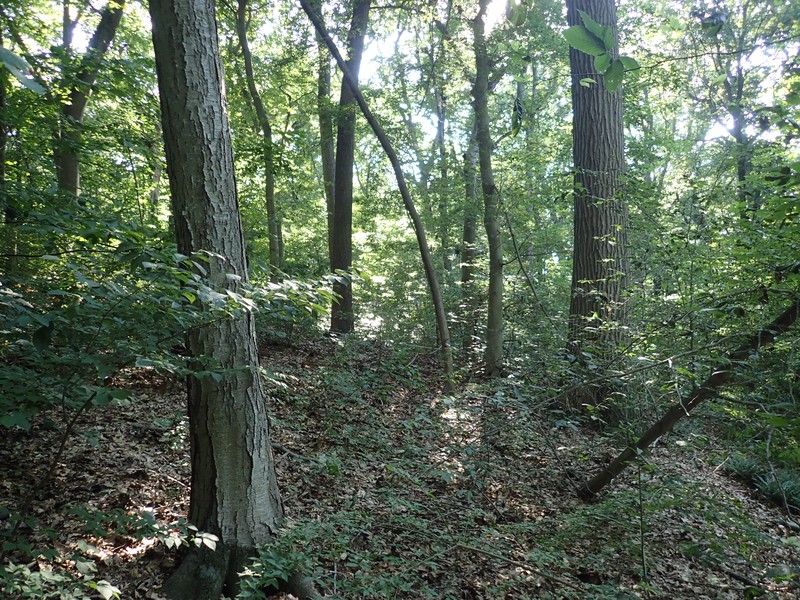
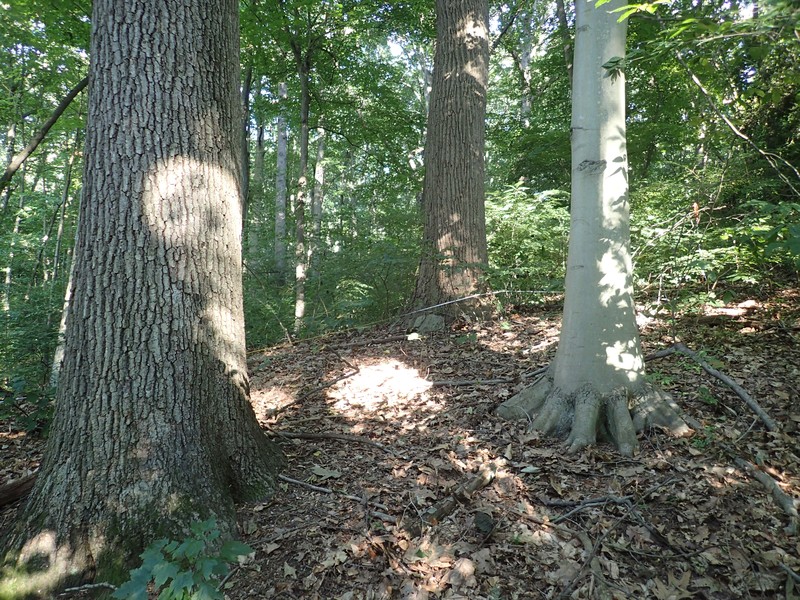
Oak tulip-tree forest is a mesophytic hardwood forest community that occurs on moist, well-drained sites in southeastern New York. The dominant trees include a mixture of oaks (Quercus spp.), tulip tree (Liriodendron tulipifera), American beech (Fagus grandifolia), black birch (Betula lenta), and red maple (Acer rubrum). The subcanopy often includes flowering dogwood (Cornus florida), and common understory associates include witch hazel (Hamamelis virginiana), sassafras (Sassafras albidum), and lowbush blueberries (Vaccinium angustifolium, V. pallidum). The herb layer is moderate to sparse and may include New York fern (Thelypteris novaboracenis), white wood aster (Eurybia divaricata), and Solomon's plume (Maianthemum racemosum).
Characters Most Useful for Identification
A moist, well-drained, closed-canopy hardwood forest with codominating tulip tree and oak species. The subcanopy often includes flowering dogwood, and other common understory associates include witch hazel, sassafras, and lowbush blueberry.
Elevation Range
Known examples of this community have been found at elevations between 10 feet and 1,360 feet.
Best Time to See
During July, two species of lowbush blueberry in the understory of this community bear fruit. In autumn, the foliage of the hardwood canopy species and the understory shrubs turn bright colors.
Oak-Tulip Tree Forest Images
D.J. Evans
Timothy Howard
Gregory J. Edinger
Gregory J. Edinger
Gregory J. Edinger
Gregory J. Edinger
Gregory J. Edinger
Gregory J. Edinger
Classification
International Vegetation Classification Associations
This New York natural community encompasses all or part of the concept of the following International Vegetation Classification (IVC) natural community associations. These are often described at finer resolution than New York's natural communities. The IVC is developed and maintained by NatureServe.
- American Beech - (White Oak, Northern Red Oak) - Tuliptree / (American Holly) Forest (CEGL006075)
NatureServe Ecological Systems
This New York natural community falls into the following ecological system(s). Ecological systems are often described at a coarser resolution than New York's natural communities and tend to represent clusters of associations found in similar environments. The ecological systems project is developed and maintained by NatureServe.
- Appalachian (Hemlock)-Northern Hardwood Forest (CES202.593)
- Northern Atlantic Coastal Plain Dry Oak-Hardwood Forest (CES203.475)
- Southern Atlantic Coastal Plain Mesic Hardwood Forest (CES203.242)
- Southern Piedmont Mesic Forest (CES202.342)
Characteristic Species
-
Trees > 5m
- Acer rubrum var. rubrum (common red maple)
- Acer saccharinum (silver maple)
- Betula lenta (black birch)
- Carya cordiformis (bitternut hickory)
- Carya glabra (pignut hickory)
- Fagus grandifolia (American beech)
- Liriodendron tulipifera (tulip tree, tulip poplar, yellow poplar)
- Quercus alba (white oak)
- Quercus coccinea (scarlet oak)
- Quercus rubra (northern red oak)
- Quercus velutina (black oak)
-
Shrubs 2 - 5m
- Hamamelis virginiana (witch-hazel)
-
Shrubs < 2m
- Lindera benzoin (spicebush)
- Vaccinium angustifolium (common lowbush blueberry)
- Vaccinium pallidum (hillside blueberry)
- Viburnum acerifolium (maple-leaved viburnum)
-
Tree saplings
- Carpinus caroliniana ssp. virginiana (musclewood, ironwood, American hornbeam)
- Castanea dentata (American chestnut)
- Cornus florida (flowering dogwood)
- Prunus serotina var. serotina (wild black cherry)
- Rubus allegheniensis (common blackberry)
- Sassafras albidum (sassafras)
-
Vines
- Parthenocissus quinquefolia (Virginia-creeper)
-
Herbs
- Allium tricoccum var. tricoccum (common wild leek)
- Arisaema triphyllum ssp. triphyllum (common jack-in-the-pulpit)
- Asarum canadense (wild ginger)
- Athyrium angustum (northern lady fern)
- Chimaphila maculata (spotted-wintergreen)
- Claytonia virginica (eastern spring-beauty)
- Conopholis americana (oak-drops)
- Epifagus virginiana (beech-drops)
- Eurybia divaricata (white wood-aster)
- Geranium maculatum (wild geranium)
- Maianthemum racemosum ssp. racemosum (false Solomon's-seal)
- Mitchella repens (partridge-berry)
- Monotropa uniflora (Indian-pipe)
- Polygonatum biflorum var. biflorum (small Solomon's-seal)
- Polystichum acrostichoides (Christmas fern)
- Pyrola elliptica (common shinleaf)
- Thelypteris noveboracensis (New York fern)
- Trillium erectum (purple trillium, stinking Benjamin)
Similar Ecological Communities
- Appalachian oak-hickory forest
(guide)
Appalachian oak-hickory forests occur on slightly drier sites and lack the richer forest species such as tulip tree, beech, and black birch that are often found in oak-tulip tree forests.
- Beech-maple mesic forest
(guide)
Beech-maple mesic forests occur in more northern (cooler) sites and are more likely to have yellow birch, beech, and sugar maple (all three together) than oak-tulip tree forests.
Vegetation
Percent cover
This figure helps visualize the structure and "look" or "feel" of a typical Oak-Tulip Tree Forest. Each bar represents the amount of "coverage" for all the species growing at that height. Because layers overlap (shrubs may grow under trees, for example), the shaded regions can add up to more than 100%.
Additional Resources
References
Augustine, A.J. and L.E. French. 1998. Effects of white-tailed deer on populations of an understory forb in fragmented deciduous forests. Conservation Biology 12:995-1004.
Carta L.K, Z.A. Handoo, L. Shiguang, M. Kantor, G. Bauchan, D. McCann, C.K. Gabriel, Q. Yu, S. Reed, J. Koch, D. Martin, and D.J. Burke. 2020. Beech leaf disease symptoms caused by newly recognized nematode subspecies Litylenchus crenatae mccannii (Anguinata) described from Fagus grandifolia in North America. Forest Pathology, 50: e12580. https://doi.org/10.1111/efp.12580
Daily, G.C., S. Alexander, P.R. Ehrlich, L. Goulder, J. Lubchenco, P. Matson, H.A. Mooney, S. Postel, S.H. Schneider, D. Tilman, and G.M. Woodwell. 1997. Ecosystem Services: benefits supplied to human societies by natural ecosystems. Issues In Ecology 2:1-16.
Edinger, G. J., D. J. Evans, S. Gebauer, T. G. Howard, D. M. Hunt, and A. M. Olivero (editors). 2014. Ecological Communities of New York State. Second Edition. A revised and expanded edition of Carol Reschke’s Ecological Communities of New York State. New York Natural Heritage Program, New York State Department of Environmental Conservation, Albany, NY. https://www.nynhp.org/ecological-communities/
Edinger, Gregory J., D.J. Evans, Shane Gebauer, Timothy G. Howard, David M. Hunt, and Adele M. Olivero (editors). 2002. Ecological Communities of New York State. Second Edition. A revised and expanded edition of Carol Reschke's Ecological Communities of New York State. (Draft for review). New York Natural Heritage Program, New York State Department of Environmental Conservation. Albany, NY. 136 pp.
Ewing C.J., C.E. Hausman, J. Pogacnik, J. Slot, and P. Bonello. 2019. Beech leaf disease: An emerging forest epidemic. Forest Pathology 49: e12488. https://doi.org/10.1111/efp.12488
Greller, Andrew M. 1977. A classification of mature forests on Long Island, New York. Bull. Torrey Bot. Club 140 (4):376-382.
Hagan, J.M. and A.A. Whitman. 2004. Late-successional Forest:A disappearing age class and implications for biodiversity. Manomet Center for Conservation Sciences. 4 pp.
Knight, T.M. 2003. Effects of herbivory and its timing across populations of Trillium grandiflorum (Liliaceae). American Journal of Botany 90:1207-1214.
Liebold, S. 2003. Gypsy Moth in North America. U.S. Department of Agriculture, Forest Service, Northeastern Research Station, Morgantown, WV.
McManus, M, N. Schneebergerm R. Reardon, and G. Mason. 1980. Gypsy Moth. Forest Insect and Disease Leaflet 162. U.S. Department of Agriculture, Forest Service, Washington, D.C.
Miller, S.G., S.P. Bratton, and J. Hadidian. 1992. Impacts of white-tailed deer on endangered and threatened vascular plants. Natural Areas Journal 12:67-74.
New York Natural Heritage Program. 2024. New York Natural Heritage Program Databases. Albany, NY.
Reed, S.E., S. Greifenhagen, Q. Yu, A. Hoke, D.J. Burke, L.K. Carta, Z.A. Handoo, M.R. Kantor, and J. Koch. 2020. Foliar nematode, Litylenchus crenatae ssp. mccannii, population dynamics in leaves and buds of beech leaf disease-affected trees in Canada and the US. Forest Pathology, 50: e12599. https://doi.org/10.1111/efp.12599
Reschke, Carol. 1990. Ecological communities of New York State. New York Natural Heritage Program, New York State Department of Environmental Conservation. Latham, NY. 96 pp. plus xi.
Rosza, R. and K. Metzler. 1982. Plant communities of Mashomack. In: The Mashomack Preserve Study. Vol. 2: Biological Resources. S. Englebright, ed. The Nature Conservancy, East Hampton, New York.
The President's Council on Sustainable Development. 1999. Towards a Sustainable America: Advancing Prosperity, Opportunity, and a Healthy environment for the 21st Century. Washington, DC. 97 pp. plus appendices.
Links
- Beech Bark Disease (Ohio State University Extension)
- Beech Bark Disease (UMass Amherst, UMass Extension)
- Beech Leaf Disease (NYS DEC)
- Beech Leaf Disease (UMass Amherst, UMass Extension)
- Fishkill Ridge (Scenic Hudson)
- Hudson Highlands State Park Preserve
- Tulip Tree (Liriodendron tlipifera) - USDA Plants
- Van Cortlandt Park (NYC Parks)
- Vanderbilt Mansion National Historic Site Trail Map (NPS)
About This Guide
This guide was authored by: Jennifer Garret
Information for this guide was last updated on: March 26, 2024
Please cite this page as:
New York Natural Heritage Program. 2024.
Online Conservation Guide for
Oak-tulip tree forest.
Available from: https://guides.nynhp.org/oak-tulip-tree-forest/.
Accessed April 25, 2024.