Riverbank Quillwort
Isoetes riparia Engelm. ex A. Braun
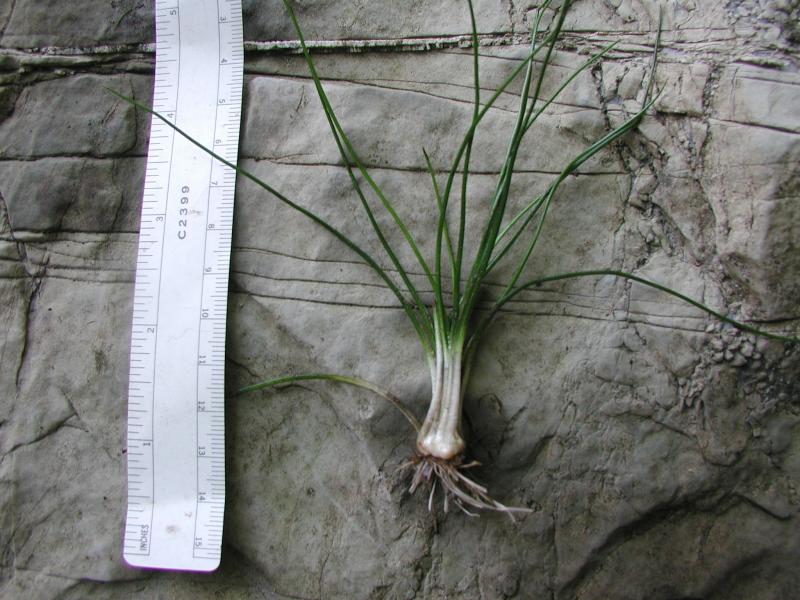
Isoetes riparia
Timothy G Howard
- Class
- Isoetopsida (Quillworts)
- Family
- Isoetaceae (Quillwort Family)
- State Protection
- Endangered
Listed as Endangered by New York State: in imminent danger of extirpation in New York. For animals, taking, importation, transportation, or possession is prohibited, except under license or permit. For plants, removal or damage without the consent of the landowner is prohibited.
- Federal Protection
- Not Listed
- State Conservation Status Rank
- S1
Critically Imperiled in New York - Especially vulnerable to disappearing from New York due to extreme rarity or other factors; typically 5 or fewer populations or locations in New York, very few individuals, very restricted range, very few remaining acres (or miles of stream), and/or very steep declines.
- Global Conservation Status Rank
- G5
Secure globally - Common in the world; widespread and abundant (but may be rare in some parts of its range).
Summary
Did you know?
Nearly all quillwort species are notorious for their promiscuity. This causes identification and problems, and results in difficulties in understanding the relationships between species. Most Isoetes species are able to cross with at least one other Isoetes species, forming both fertile and sterile hybrids. These crossings have even resulted in new species. This is a complex group that challenges how one defines a species.
State Ranking Justification
As of 2005, there are two known and verified populations. A population from Mohonk Lake was last reported in the late 1970s and there is no reason to suspect that it has disappeared. There are also reports of large populations on the Vermont side from the northern portion of Lake Champlain. In the early to mid 1900s, many populations were reported along the Hudson River but these appear to have completely disappeared. There are also historical records from the St. Lawrence Seaway that have not been observed in many years. This species may have been negatively impacted by water quality degradation, or this is a much overlooked species.
Short-term Trends
There are numerous historical records, but only two known populations. Additional populations are very likely, but surveys targetting this species along the Hudson River have not relocated any of these historical populations. There is a good possibility that this plant is no longer present along the Hudson River, but should be expected from the northern portion of Lake Champlain.
Long-term Trends
This plant was likely much more common throughout the state when the waterways were more pristine. As these waterways have been impacted, there is a high likelihood that populations of this plant were lost. Few early botanists concentrated on aquatic species, so there is not a lot evidence to support this claim. At this time, this negative long-term trend is very speculative.
Conservation and Management
Threats
Certain populations of this plant have been negatively impacted by pollutants, run-off, boat traffic, and other changes to their associated waterways. Some populations are most insulated from these activities and have very few threats. The areas under the greatest threats (e.g. Hudson River) have seen the greatest decline in populations.
Conservation Strategies and Management Practices
At this time, the management needs for this species are not well known. These needs would presumably include maintaining and protecting the high quality waterways where this plant is found.
Research Needs
More work is needed to determine this species habitat requirements. There is also a report of Isoetes acadiensis from the Adirondacks; however, since this keys out so close to Isoetes riparia, the specimen should be verified by another expert. Studies to determine the impacts of water quality changes should also be investigated. This would allow for a better understanding of the management needs for this species.
Habitat
Habitat
An aquatic plant found along pond margins, cobble shorelines of large rivers, tidal mudflats, and shallow gravelly areas of lakes (New York Natural Heritage Program 2004). Infrequent in shallow water and shores of slow-moving rivers and streams and intertidal mud flats (Rhoads and Block 2000). Margins of lakes, ponds, and streams; tidal shores and estuaries; calcareous to slighly acidic substrates in fresh, usually oligotrophic, water (Flora of North America 1993). Gravelly or muddy, tidal or non-tidal, fresh-water shores. In ponds, streams, and fresh or slightly brackish rivers, rooted in gravel or mud (Gleason and Cronquist 1991). Fresh or tidal shores and shallow water (Fernald 1970).
Associated Ecological Communities
- Brackish intertidal mudflats
(guide)
A sparsely vegetated community, characterized by low-growing, rosette-leaved aquatics. The community occurs on exposed intertidal mudflats where water salinity ranges from 0.5 to 18.0 ppt. This community is best developed where mudflats are nearly level so that broad expanses are exposed at low tide. The rosette-leaved aquatics are completely submerged at high tide, and they are usually coated with mud.
- Cobble shore wet meadow
(guide)
A community that occurs on the cobble shores of lakes and streams where the substrate is moist from seepage or intermittent flooding. These communities are likely to be scoured by floods or winter ice floes, but there is apparently no significant accumulation of pack ice.
- Confined river
(guide)
The aquatic community of relatively large, fast flowing sections of streams with a moderate to gentle gradient.
- Freshwater intertidal mudflats
(guide)
A sparsely vegetated community characterized by low rosette-leaved aquatics. This community occurs on exposed intertidal mudflats where the water is fresh (salinity less than 0.5 ppt). This community is best developed where mudflats are nearly level so that broad expanses are exposed at low tide. The plants are completely submerged in 0.9 to 1.2 m (3 to 4 ft) of water at high tide and they are usually coated with mud.
- Inland calcareous lake shore
(guide)
The gravelly, sandy, or muddy shore of an inland lake or pond with calcareous water and seasonally fluctuating water levels. There may be few plants and those that are present are usually herbaceous.
- Oligotrophic dimictic lake*
(guide)
The aquatic community of a nutrient-poor lake that typically occurs in a deep, steeply-banked basin. These lakes are dimictic: they have two periods of mixing or turnover (spring and fall), they are thermally stratified in the summer, and they freeze over and become inversely stratified in the winter.
- Oligotrophic pond*
(guide)
The aquatic community of a small, shallow, nutrient-poor pond. The water is very clear, and the bottom is usually sandy or rocky.
- Unconfined river
(guide)
The aquatic community of large, quiet, base level sections of streams with a very low gradient.
* probable association but not confirmed.
Associated Species
- Ceratophyllum demersum (common coon-tail)
- Elodea nuttallii (Nuttall's waterweed)
- Eriocaulon aquaticum (northern pipewort, northern hat-pins)
- Justicia americana (American water-willow)
- Podostemum ceratophyllum (riverweed, thread-foot)
- Sagittaria cuneata (northern arrowhead)
Range
New York State Distribution
There is one known population from the Taconics and another along the Delaware River. A population was reported from Mohonk Lake (Shawangunk Mountains), but this has not been verified since the late 1970s. Based on its presence on the Vermont side, there are reasons to believe that this plant could be found in the northern portions of Lake Champlain. Historically this was relatively abundant along the Hudson River and at scattered locations along the St. Lawrence Seaway.
Global Distribution
This aquatic plant ranges from southern Quebec and Ontario, south through eastern New York and western New England, down to the coastal plain of North Carolina.
Identification Comments
General Description
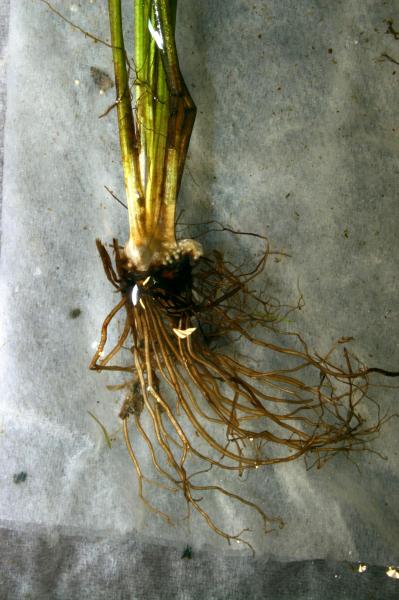
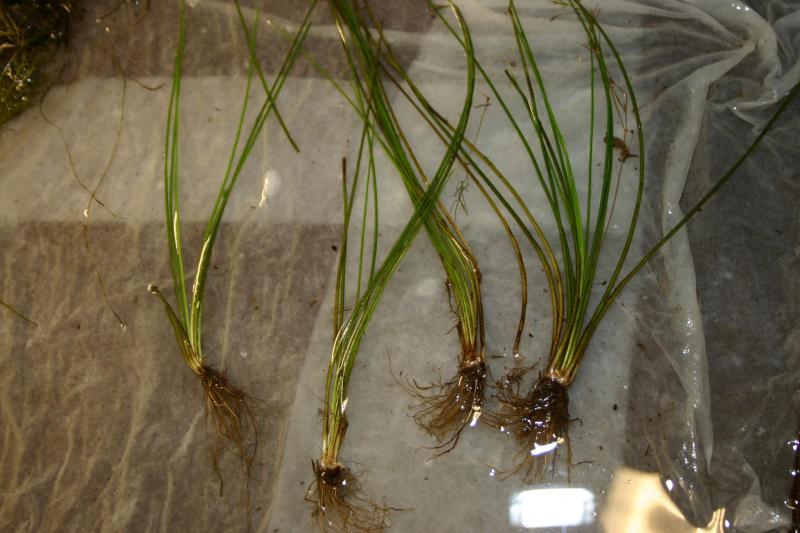
This amphibious plant has dark, green and stiff leaves. The "fruits" or megaspores are found near the base of the leaves within bulbous pouches. A study of the spores under magnification reveal interesting spheres with ridges and craters. The best way to identify any of the quillworts is by studying the differences in these ridges and craters.
Identifying Characteristics
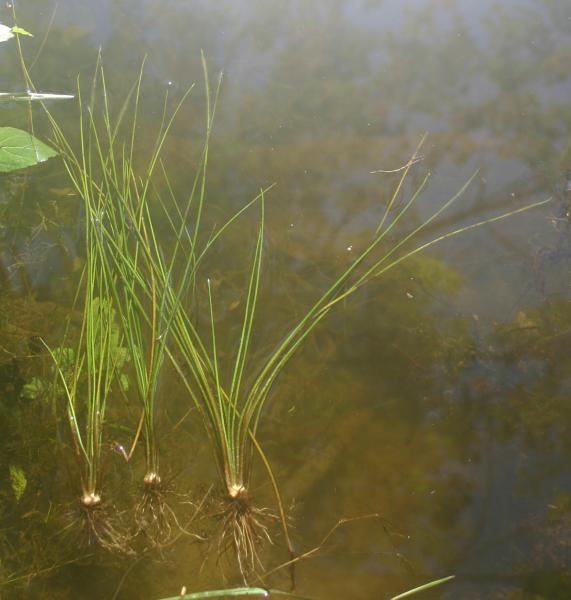
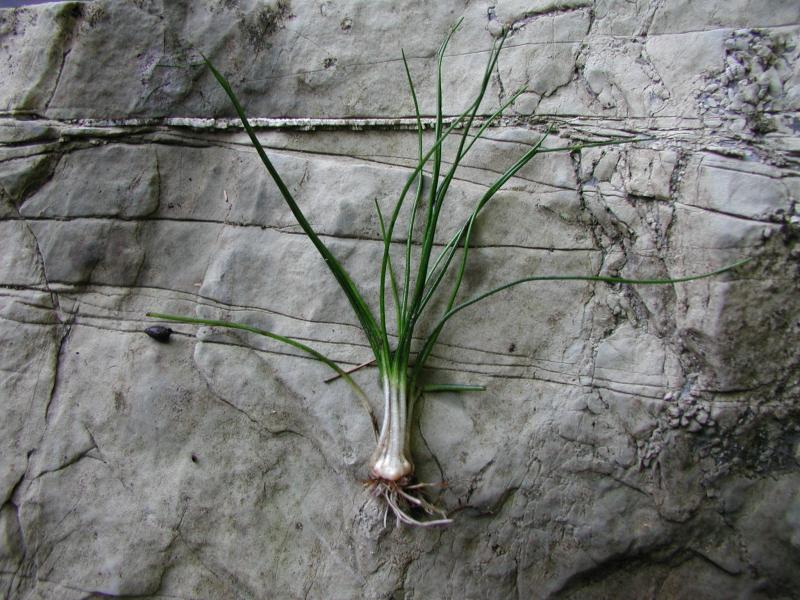
This plant in considered amphibious, found mostly in submerged aquatic settings but also known from shoreline areas where the roots may be in wet soil and the leaves are fully exposed to the open air. The leaves are bright green, 10-35 cm long (rarely to 50 cm long). These leaves are mostly without peripheral strands and with stomata present. The sporangia are oblong, 4-7 mm long. The spores bear conspicuous jagged crests with sharp distinct or slightly confluent peaks.
Best Life Stage for Proper Identification
Most Isoetes are difficult to identify and this species is no exception. To ensure proper identification, mature megaspores are required. Due to the small size of these spores, a voucher specimen should be collected.
Similar Species
Isoetes tuckermanii has leaves without stomata and peripheral strands, a sporangia that is 2-5 cm long and one-third covered by the velum, and megaspores with nearly rectangular reticulation and a girdle that is densely papillate. Isoetes lacustris has megaspores averaging 0.7 mm in diameter. Isoetes engelmannii has megaspores averaging less than 0.5 mm diameter and without a girdle. Isoetes acadiensis has megaspores with a smooth girdle and ridges with rounded and smooth crests.
Best Time to See
Vegetative stems are present from late June to early October. As the season progresses, floating plants may be encountered. Mature spores should be present in August and September, and even to October. This is when surveys should be conducted. Mature spores are necessary to properly identify this species and could persist into October.
- Fruiting
The time of year you would expect to find Riverbank Quillwort fruiting in New York.
Riverbank Quillwort Images
Timothy G Howard
Troy Weldy
Troy Weldy
Timothy G Howard
Troy Weldy
Taxonomy
Riverbank Quillwort
Isoetes riparia Engelm. ex A. Braun
- Kingdom Plantae
- Phylum Lycophyta
- Class Isoetopsida
(Quillworts)
- Order Isoetales
- Family Isoetaceae (Quillwort Family)
- Order Isoetales
- Class Isoetopsida
(Quillworts)
- Phylum Lycophyta
Additional Common Names
- Quillwort
- Shore Quillwort
Synonyms
- Isoetes canadensis (Engelm.) A.A. Eat.
- Isoetes dodgei A. Eaton [This probably reflects a hybridization between Isoetes riparia and Isoetes echinospora.]
- Isoetes riparia var. amesii (A.A. Eat.) Proctor
- Isoetes riparia var. canadensis Engelm.
- Isoetes riparia var. riparia
- Isoetes riparia var. robbinsii (A. Eaton) Proctor
- Isoetes saccharata Engelm.
- Isoetes saccharata var. amesii A.A. Eat.
Comments on the Classification
Isoetes riparia appears to be an allotetraploid (2n=44), meaning that it is a species of hybrid origin where the chromosomes doubled after the initial hybridization to produce a new fertile species. The original parents were likely Isoetes echinospora and Isoetes engelmannii. The hybrid between this two species is typically called Isoetes x eatonii. Isoetes x eatonii is the sterile hybrid between these parents, while Isoetes riparia probably resulted from the doubling of chromosomes within Isoetes x eatonii. Isoetes riparia may hybridize with Isoetes echinospora, Isoetes engelmanii, Isoetes lacustris, or Isoetes tuckermanii (Flora of North America 1993).
Additional Resources
Best Identification Reference
Flora of North America Editorial Committee. 1993. Flora of North America, North of Mexico. Volume 2. Pteridophytes and Gymnosperms. Oxford University Press, New York. 475 pp.
Other References
Fernald, M.L. 1950. Gray's manual of botany. 8th edition. D. Van Nostrand, New York. 1632 pp.
Gleason, Henry A. and A. Cronquist. 1991. Manual of Vascular Plants of Northeastern United States and Adjacent Canada. The New York Botanical Garden, Bronx, New York. 910 pp.
Holmgren, Noel. 1998. The Illustrated Companion to Gleason and Cronquist's Manual. Illustrations of the Vascular Plants of Northeastern United States and Adjacent Canada. The New York Botanical Garden, Bronx, New York.
Mitchell, Richard S. and Gordon C. Tucker. 1997. Revised Checklist of New York State Plants. Contributions to a Flora of New York State. Checklist IV. Bulletin No. 490. New York State Museum. Albany, NY. 400 pp.
New York Natural Heritage Program. 2024. New York Natural Heritage Program Databases. Albany, NY.
Reschke, Carol. 1990. Ecological communities of New York State. New York Natural Heritage Program, New York State Department of Environmental Conservation. Latham, NY. 96 pp. plus xi.
Rhoads, Ann F. and Timothy A. Block. 2000. The Plants of Pennsylvania, an Illustrated Manual. University of Pennsylvania Press, Philadelphia, PA.
Weldy, T. and D. Werier. 2010. New York flora atlas. [S.M. Landry, K.N. Campbell, and L.D. Mabe (original application development), Florida Center for Community Design and Research http://www.fccdr.usf.edu/. University of South Florida http://www.usf.edu/]. New York Flora Association http://newyork.plantatlas.usf.edu/, Albany, New York
Links
About This Guide
Information for this guide was last updated on: February 15, 2005
Please cite this page as:
New York Natural Heritage Program. 2024.
Online Conservation Guide for
Isoetes riparia.
Available from: https://guides.nynhp.org/riverbank-quillwort/.
Accessed April 17, 2024.