Crawe's Sedge
Carex crawei Dewey
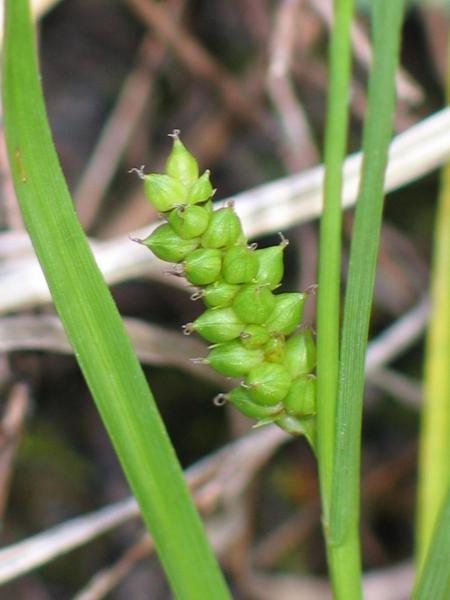
Carex craweii
David Werier
- Class
- Monocotyledoneae (Monocots)
- Family
- Cyperaceae (Sedge Family)
- State Protection
- Threatened
Listed as Threatened by New York State: likely to become Endangered in the foreseeable future. For animals, taking, importation, transportation, or possession is prohibited, except under license or permit. For plants, removal or damage without the consent of the landowner is prohibited.
- Federal Protection
- Not Listed
- State Conservation Status Rank
- S2
Imperiled in New York - Very vulnerable to disappearing from New York due to rarity or other factors; typically 6 to 20 populations or locations in New York, very few individuals, very restricted range, few remaining acres (or miles of stream), and/or steep declines.
- Global Conservation Status Rank
- G5
Secure globally - Common in the world; widespread and abundant (but may be rare in some parts of its range).
Summary
Did you know?
The specific epithet crawei is named after Ithamar Bingham Crawe, 1792-1847, who discovered this plant (Fernald 1970). Valcour Island, located in Lake Champlain near Plattsburgh, is the best place in New York to find Carex crawei.
State Ranking Justification
There are nine known populations, but three of these only have a few plants. The largest populations have over a 10,000 stems. These are primarily restricted to limestone pavement areas and other types of sites associated with calcareous bedrock. This type of habitat is very limiting. Some of these sites face battles with various invasive species. There are a few historical sites and the possibility that this plant has been overlooked. More survey work is needed at the sites with small populations reported, as well as at sites where habitat conditions seem suitable.
Short-term Trends
There are eight populations which have been seen in recent years. No clear trends are available for these populations but at least five of the populations are very large and extensive. The other three vary from very small (one or two plants) to medium sized. These small populations are probably declining or perhaps other parts of these populations were overlooked during survey work. Therefore, short term trends are unknown but may indicate at least a small decline.
Long-term Trends
There are at least 7 populations which have not been seen in recent years. Dedicated surveys to relocate these populations have not been conducted and it is unknown if these populations are still extant. Three populations that have been seen in recent years are very small to medium sized. Two of these have only one or two plants present. Therefore, either parts of these populations were overlooked during survey work or these populations are probably declining. Overall, long term trends are not clear but may indicate at least a small decline.
Conservation and Management
Threats
Currently there is no real threat to any of the known populations of C. crawei. Some potential threats include trampling by hikers at one population and heavy grazing and ATV use at another population. A third population that occurs in a rich fen appears to be doing really well in an old path that is no longer in regular use. As the old path fills in with vegetation this population may become less common and perhaps reflect pre-disturbance levels.
Conservation Strategies and Management Practices
No management is currently needed but monitoring should be done to see if ATV use or trampling by hikers is damaging populations. If this is determined to be occurring, then efforts should be made to protect these populations from these threats.
Research Needs
Surveys should be conducted to historical populations. Since this species is very specific in its habitat preferences in New York, surveys should also be conducted where additional potential habitat exists.
Habitat
Habitat
Carex crawei occurs in limestone pavement areas (alvars) usually where there is no canopy and graminoids dominate. In these alvar systems, it can also occur in seasonally wet depressions of less vegetated areas. Carex crawei also grows on calcareous cobble shores of lakes and rivers usually in seepy areas and where ice scour occurs. Carex crawei also occurs in marl fens. In these marl fens it prefers growing where the substrate is visible and the vegetation is not dense (New York Natural Heritage Program 2006). Dry to usually moist, open ground, often associated with calcareous gravels or limestone pavements, in wet meadows, fens, prairie swales, beach pools, shores and glades, less commonly edges of white-cedar thickets, prairie patches along rights-of-way, streams, ditches, and quarries (Cochrane and Naczi 2002). Wet meadows, shores, and rock-ledges in calcareous districts (Gleason and Cronquist 1991). Calcareous shores, gravels, meadows, and glades (Fernald 1970).
Associated Ecological Communities
- Alvar pavement grassland
(guide)
This community consists of exposed, flat limestone or dolostone pavement with grassy or mossy patches interspersed throughout. Some examples may be solely grassland with no pavement.
- Calcareous shoreline outcrop
(guide)
A community that occurs along the shores of lakes and streams on outcrops of calcareous rocks such as limestone and dolomite. The vegetation is sparse; most plants are rooted in rock crevices.
- Cobble shore
(guide)
A community that occurs on the well-drained cobble shores of lakes and streams. These shores are usually associated with high-energy waters (such as high-gradient streams), and they are likely to be scoured by floods or winter ice floes.
- Marl fen
(guide)
A wetland that occurs on a bed of marl. Marl is a whitish substance that is deposited from water that has a lot of calcium dissolved in it. The whitish substance is calcium carbonate, people used to harvest marl to lime agricultural fields. The marl substrate is always saturated, may be flooded, and has a very high pH, generally greater than 7.5. The main source of water is always groundwater. The plants are often sparse and stunted. Marl fens may occur as small patches within a rich graminoid fen.
- Riverside ice meadow
(guide)
A meadow community that occurs on gently sloping cobble shores and rock outcrops along large rivers in areas where winter ice floes are pushed up onto the shore, forming an ice pack that remains until late spring. The ice scours the meadow, cutting back woody plants.
Associated Species
- Allium schoenoprasum (chives)
- Carex flava (yellow sedge)
- Carex sterilis (dioecious sedge)
- Cladium mariscoides (twig-rush)
- Deschampsia cespitosa (tufted hair grass)
- Eleocharis compressa var. compressa (flat-stemmed spike-rush)
- Juniperus horizontalis (creeping juniper)
- Myrica pensylvanica
- Packera paupercula (balsam groundsel)
- Rhamnus alnifolia (alder-leaved buckthorn)
- Spiranthes lucida (shining ladies'-tresses)
- Sporobolus heterolepis (prairie dropseed)
- Symphyotrichum tradescantii (Tradescant's-aster)
- Zigadenus elegans ssp. glaucus
Range
New York State Distribution
Carex crawei is known from western, north-central, and northern New York. It is mostly widely scattered in isolated populations but in Jefferson County just east of Lake Ontario there are a number of populations that occur close together.
Global Distribution
Carex crawei is a wide ranging species but is rare or local except in a few areas. It occurs from British Columbia east to Quebec and Newfoundland south to New Jersey, Virginia, Georgia, Mississippi, Arkansas, Oklahoma, Wyoming, Utah, and Washington (Cochrane and Naczi 2002).
Identification Comments
General Description
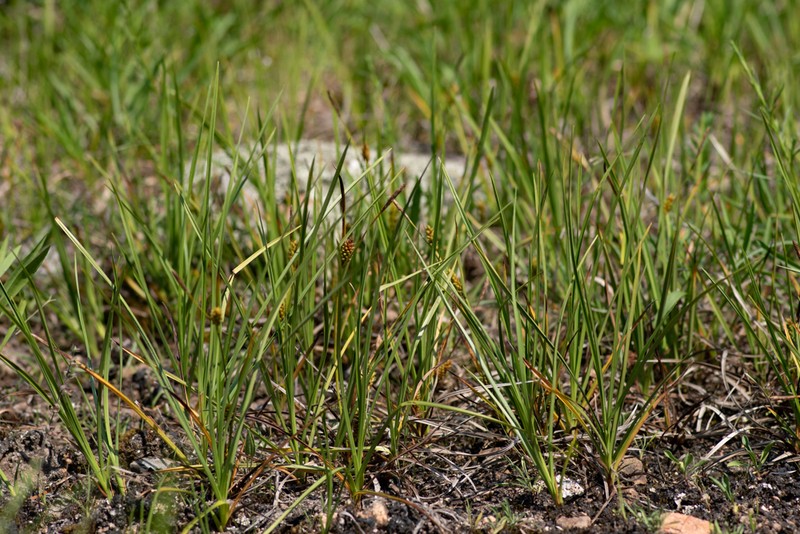
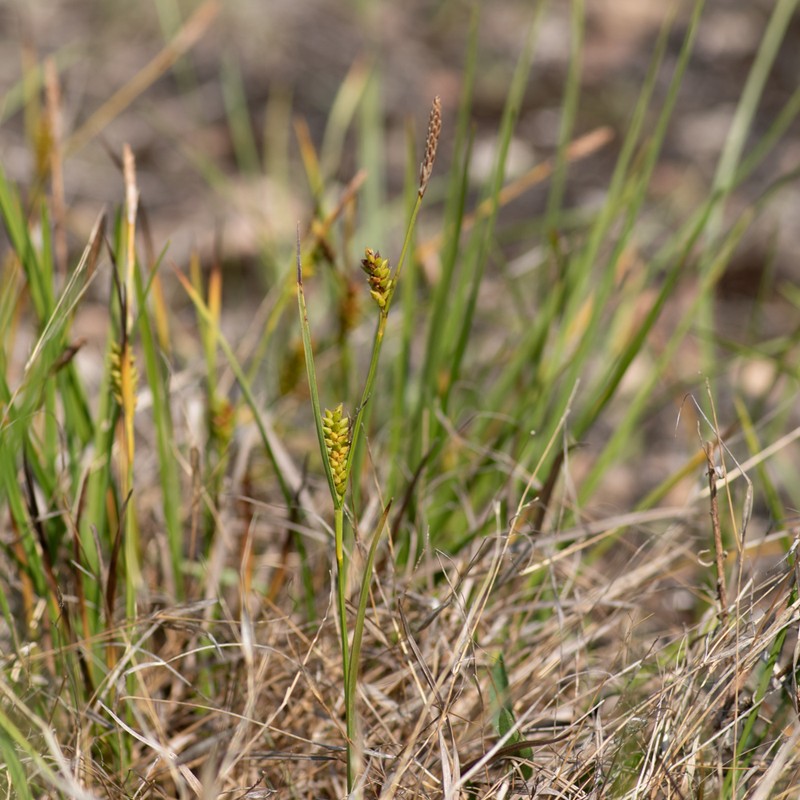
Crawe's sedge is a grass-like perennial that has long rhizomes and grows in patches. Stems mostly arise singly from the rhizomes and are 2-40 cm tall. Leaves are strap-like, clustered near the bases of the plants, and are 1.8-4.4 mm wide. Towards the apex of the stems are 3-5 narrowly cylindrical flower/fruit clusters (spikes). The terminal spike is composed of male flowers while the other spikes are composed of female flowers. The female flowers mature into fruits (perigynia) which are yellowish green to pale brown and 2.2--3.7 mm long (Cochrane and Naczi 2002).
Identifying Characteristics
Carex crawei is long rhizomatous and somewhat colonial. Leaves are 1.5-4.4 mm wide, thick, and light green. Culms are 2-30(-40) cm long and solitary or rarely in groups of 2. The terminal spike is staminate, occassionally has a short additional one just proximal, and is on a peduncle (0.4-)0.9-7.6(-9.1) cm long. There are 2-4 lateral pistillate spikes which are 5-27 mm long and widely separated. The lowest spikes originate in the lower part of the culms and sometimes from near the bases of the plants. Bracts are usually shorter than the culms. Perigynia are yellowish-green to pale brown and 2.2-3.4(-3.7) mm long with a beak 0.1-0.3 mm long. The apex of the beak is entire or has minute teeth up to 0.1 mm long (Mackenzie 1931-1935, Cochrane and Naczi 2002).
Best Life Stage for Proper Identification
Carex crawei is easiset to identify when the perigynia are just immature to mature but are not easily shedding.
Similar Species
Carex crawei is a fairly distinctive sedge. Its long rhizomatous and non-cespitose habit separates it from most other closely related species. It can also be distinguished from the closely related C. granularis by its longer staminate peduncles and lowest pistillate spikes arising on the lower half of the stems. In comparison, C. granularis has a shorter staminate peduncle and the lowest pistillate spikes arise on the upper half of the stems. Some members of section Paniceae grow in a similar habitat to C. crawei and may appear somewhat similar due to their elongated rhizomes. Members of section Paniceae usually have pistillate spikes with perigynia less densely arranged and with less that 25 perigynia per spike. In comparison, C. crawei has pistillate spikes with perigynia more densely arranged and with at least 25 perigynia per spike.
Best Time to See
Carex crawei starts to produce immature perigynia in late May or early June. These mature and persist till mid July or a little later. During the later part of this season the perigynia are starting to shed easily. Therefore, the best time to survey for this species is June through early July.
- Fruiting
The time of year you would expect to find Crawe's Sedge fruiting in New York.
Crawe's Sedge Images
David Werier

F.R. Wesley
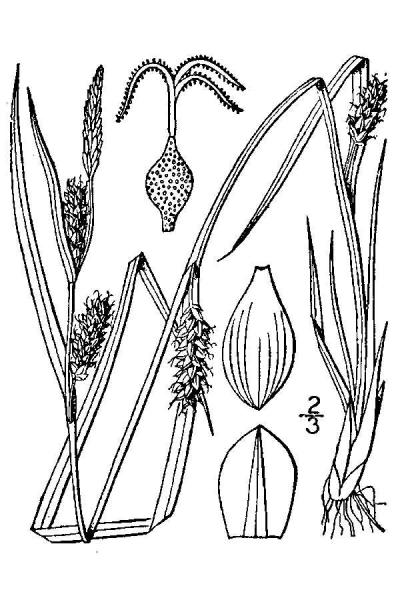
Britton, N.L., and A. Brown (1913); downloaded from USDA-Plants Database.
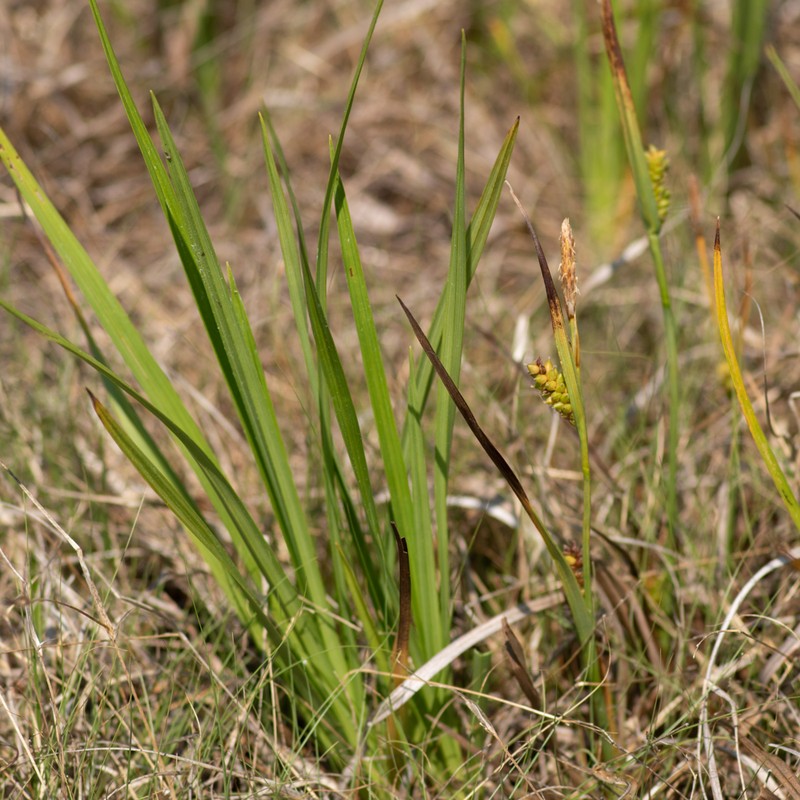
Kyle J. Webster
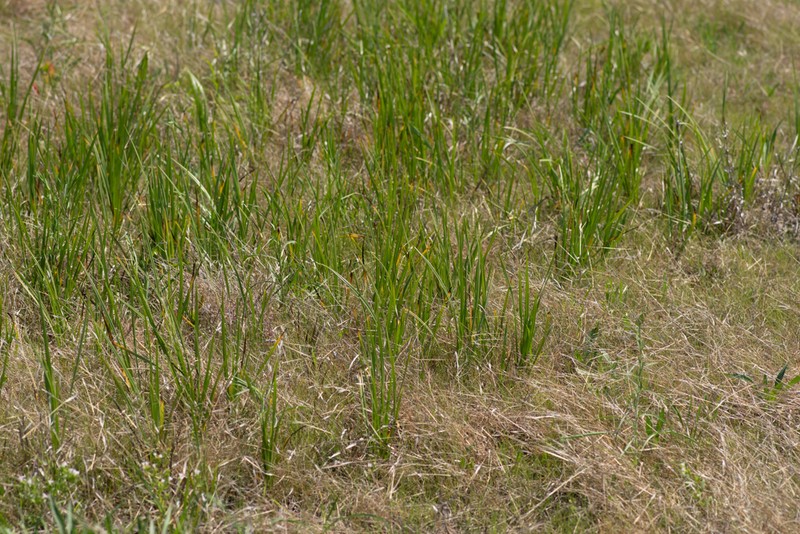
Kyle J. Webster
Kyle J. Webster
Kyle J. Webster
Taxonomy
Crawe's Sedge
Carex crawei Dewey
- Kingdom Plantae
- Phylum Anthophyta
- Class Monocotyledoneae
(Monocots)
- Order Cyperales
- Family Cyperaceae (Sedge Family)
- Order Cyperales
- Class Monocotyledoneae
(Monocots)
- Phylum Anthophyta
Additional Common Names
- Sedge
Comments on the Classification
Some C. crawei specimens from New York have perigynia characteristics that approach the similar C. microdonta. Carex microdonta is known only form the southern United States. Carex crawei is in section Granulares. This section is considered to be monophyletic and closely related to sections Careyanae and Griseae (Cochrane and Naczi 2002).
Additional Resources
Best Identification Reference
Cochrane, T.S. and R.F.C. Naczi. 2002. Carex Linnaeus sect. Granulares O. Lang. Pages 440-442 in Flora of North America Editorial Committee (editors), Flora of North America, North of Mexico, Volume 23, Magnoliophyta: Commelinidae (in part): Cyperaceae. Oxford University Press, New York, New York, USA. 608pp + xxiv.
Other References
Fernald, M.L. 1950. Gray's manual of botany. 8th edition. D. Van Nostrand, New York. 1632 pp.
Gleason, Henry A. and A. Cronquist. 1991. Manual of Vascular Plants of Northeastern United States and Adjacent Canada. The New York Botanical Garden, Bronx, New York. 910 pp.
Holmgren, Noel. 1998. The Illustrated Companion to Gleason and Cronquist's Manual. Illustrations of the Vascular Plants of Northeastern United States and Adjacent Canada. The New York Botanical Garden, Bronx, New York.
Mackenzie, K.K. 1931-1935. Cariceae. North American Flora 18: 1-478.
New York Natural Heritage Program. 2010. Biotics database. New York Natural Heritage Program. New York State Department of Environmental Conservation. Albany, NY.
New York Natural Heritage Program. 2024. New York Natural Heritage Program Databases. Albany, NY.
Reschke, Carol. 1990. Ecological communities of New York State. New York Natural Heritage Program, New York State Department of Environmental Conservation. Latham, NY. 96 pp. plus xi.
Weldy, T. and D. Werier. 2010. New York flora atlas. [S.M. Landry, K.N. Campbell, and L.D. Mabe (original application development), Florida Center for Community Design and Research http://www.fccdr.usf.edu/. University of South Florida http://www.usf.edu/]. New York Flora Association http://newyork.plantatlas.usf.edu/, Albany, New York
Links
About This Guide
Information for this guide was last updated on: October 25, 2022
Please cite this page as:
New York Natural Heritage Program. 2024.
Online Conservation Guide for
Carex crawei.
Available from: https://guides.nynhp.org/crawes-sedge/.
Accessed April 25, 2024.