Spiny Oakworm Moth
Anisota stigma (Fabricius, 1775)
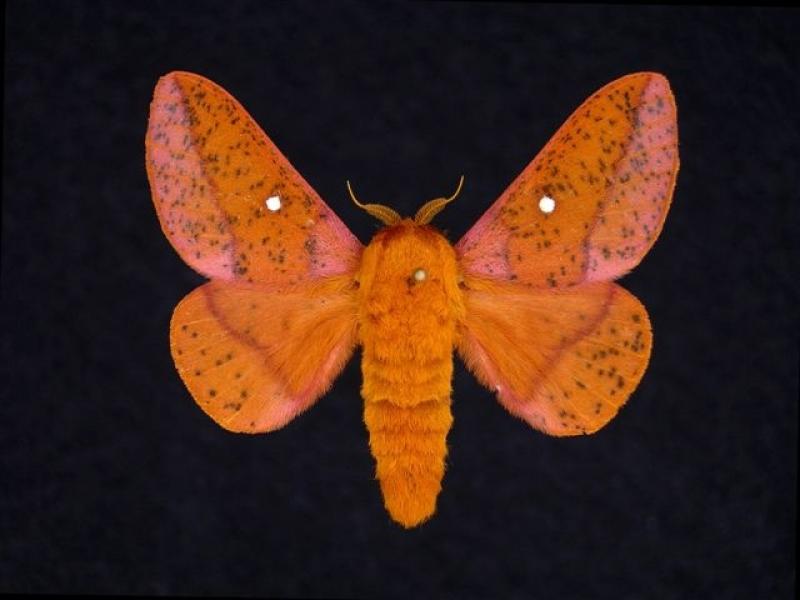
Spiny Oakworm Moth
Jim Vargo
- Class
- Insecta (Insects)
- Family
- Saturniidae (Giant Silkworm and Royal Moths)
- State Protection
- Not Listed
Not listed or protected by New York State.
- Federal Protection
- Not Listed
- State Conservation Status Rank
- SU
Unrankable - Currently unrankable due to lack of information or due to substantially conflicting information about status or trends.
- Global Conservation Status Rank
- G5
Secure globally - Common in the world; widespread and abundant (but may be rare in some parts of its range).
Summary
Did you know?
The spiny oakworm caterpillar is just that,very spiny. Fortunately, this species is classified as "non-stinging". It bears a pair of long, dangerous-looking but harmless spines on the thorax. The spiny oakworm is part of a small group of similarly "horned" caterpillars with two long, curved spines behind the head.
State Ranking Justification
Within New York State, the spiny oakworm moth is known to occur in only one population on Long Island, in dwarf pine barrens in Suffolk County. North of New Jersey, the species is highly habitat specific and is known to occur only in pine barrens and scrub habitats (Wagner et al. 2003; NatureServe 2010). The species is very rare in Pennsylvania and Massachusetts, and it is extirpated or historical from the rest of New England. It might also be very rare in New York State (Schweitzer 1996). However, additional populations might still be found in pine barrens and scrub habitats, and additional surveys are needed to better understand its status and distribution in the state.
Short-term Trends
The short-term trend for the spiny oakworm moth in New York State indicates that the population is stable. The presence of the species over multiple years at the one documented population in the state indicates that the population is viable and is reproducing.
Long-term Trends
The spiny oakworm moth is known to have declined in the Northeast (Wagner 2005). The long-term trend for the species in New York State is unknown, but on Long Island the species has probably declined from historical numbers due to habitat loss from development and the suppression of fires. Currently, the one general area that the moth is known to occupy is owned by several public entities and private owners.
Conservation and Management
Threats
Known threats include habitat loss due to development and fire suppression, although the threat of development for the remaining habitat on Long Island may be low. The suppression of fires in barrens and other dry places would cause a loss of habitat for the species and therefore a drop in population size. This species requires open woodland or barrens with pitch pine and scrub oaks. Forest fires are needed, on average, every 5-10 years (Jordan et al. 2003) to maintain this type of habitat. Lack of fires will result in the succession of this community to a closed canopy forest of tall oaks and other hardwoods (Little 1979, Jordan et al. 2003). Conversely, a fire affecting an entire occurrence could eliminate all life stages that are present. On a local scale, severe defoliation of oaks by spongy moth (Lymantria dispar) could be a threat. Treatment for the control of spongy moth, such as spaying of Bt, would also need to be evaluated to determine its effect on this species.
Conservation Strategies and Management Practices
The best management strategy for this species is the management of the natural community or habitat where this species occurs. Maintaining the Long Island pine barrens with their full suite of plant and animal species requires frequent (every few decades) disturbance to maintain open-canopy, shrub-dominated communities and to prevent succession to a closed-canopy hardwood forest (Jordan et al. 2003). Researchers have determined that "an active fire management program utilizing prescribed fire with appropriate mechanical treatments" is the preferred method (Jordan et al. 2003). Researchers have also determined that the size, type, intensity, and timing of fires (pyrodiversity) needs to be evaluated for each site to maximize benefits to the natural community and the species it supports (Jordan et al. 2003). The entire occupied habitat for a population should not be burned in a single year. For example, in places where prescribed burning is used, refugia (unburned areas) are needed for many species to ensure that any life stage can survive a fire.
Research Needs
Additional inventory and monitoring is needed. The spiny oakworm moth can be sought at blacklight traps left in pine barrens and scrub habitats in July. In addition, the response of the species to management practices such as controlled burns and mechanical removal of vegetation should be evaluated.
Habitat
Habitat
In the southern part of the spiny oakworm moth's range, it occurs in a variety of habitats, including mixed hardwood forests. Northward, however, it becomes increasingly a barrens or scrub habitat specialist, inhabiting pitch pine-scrub oak barrens and scrub oak thickets (Wagner et al. 2003, NatureServe 2010).
Associated Ecological Communities
- Dwarf pine plains
(guide)
A woodland community dominated by dwarf individuals of pitch pine and scrub oak that occurs on nearly level outwash sand and gravel plains in eastern Long Island. The soils are infertile, coarse textured sands that are excessively well-drained.
- Pitch pine-oak-heath woodland
(guide)
A pine barrens community that occurs on well-drained, infertile, sandy soils. The structure of this community is intermediate between a shrub-savanna and a woodland. Pitch pine and white oak are the most abundant trees.
Associated Species
- Barrens Dagger Moth (Acronicta albarufa) (guide)
- Herodias or Pine Barrens Underwing (Catocala herodias gerhardi) (guide)
- Jersey Jair Underwing (Catocala jair ssp. 2) (guide)
- Packard's Lichen Moth (Cisthene packardii) (guide)
- Violet Dart (Euxoa violaris) (guide)
- A Prominent Moth (Heterocampa varia) (guide)
- Yellow-spotted Graylet (Hyperstrotia flaviguttata) (guide)
- Pin-striped Slug Moth (Monoleuca semifascia) (guide)
- Pink Sallow (Psectraglaea carnosa) (guide)
- Barrens Itame (Speranza exonerata) (guide)
- Toothed Apharetra (Sympistis dentata) (guide)
- Pine Barrens Zale (Zale lunifera) (guide)
Range
New York State Distribution
The spiny oakworm moth is known to occur on Long Island. In New York State, it is a barrens or scrub habitat specialist, found in pitch pine-scrub oak barrens and scrub oak thickets (Wagner et al. 2003, NatureServe 2010).
Global Distribution
The spiny oakworm moth is known from the Atlantic Coast from southern New England to central Florida, west to southern Ontario and Minnesota, south to central Texas (Tuskes et al. 1996). It is common to abundant in southern New Jersey and much of the south. It is extirpated or historical in New England except for Massachusetts, where it is very rare. It is also very rare in Pennsylvania (Schweitzer 1996).
Identification Comments
Identifying Characteristics
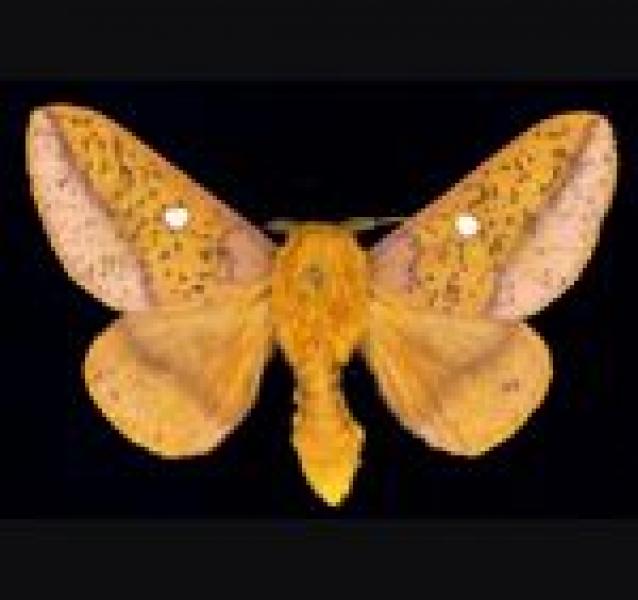
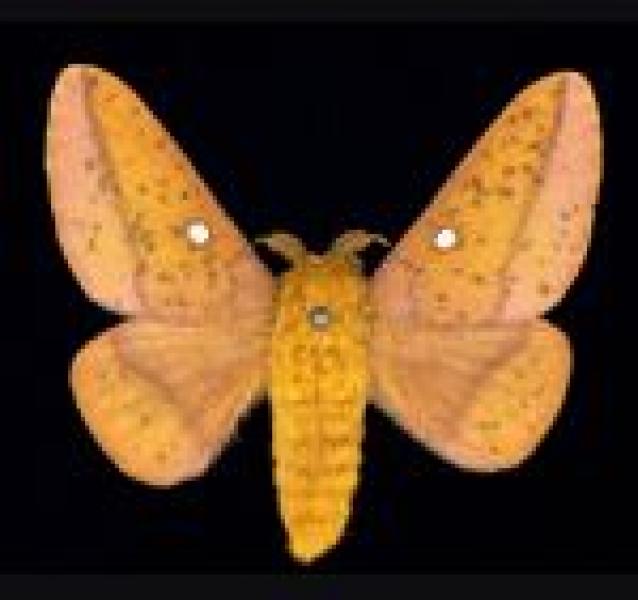
The spiny oakworm moth is a colorful moth. Its wingspan is approximately 40-70 mm. The forewings are pale to dark reddish orange, with many small black specks and a white reniform spot. The hind wings are similarly colored and have a darker median line (Covell 1984). Females are larger than males. Larvae (caterpillars) are various colors, but they have short spines and a longer pair of "horns." Eggs are yellowish (Tuskes et al. 1996).
Behavior
There is one generation each year. In New York State, adults lay eggs in clusters of 5-20 on oaks (Quercus spp.) in July. Eggs hatch in approximately 2 weeks. Larvae (caterpillars) feed on oaks during the fall. Early instar larvae feed together in groups. Later instar larvae feed alone. Pupae overwinter in a chamber underground. After emerging in the summer, adults have been observed to mate during the day, and females have been observed laying eggs at night. Females have also been observed releasing pheromones to attract males between 1 am and 3 am (Tuskes et al. 1996).
Diet
In southern New England and New York State, larvae feed on oaks (Quercus spp.), especially scrub oak (Q. ilicifolia) and scrub chestnut oak (Q. prinoides) (Wagner et al. 2003).
Best Time to See
The best time to see the spiny oakworm moth is during its flight season. In New York State, it has been captured flying in July.
- Present
- Reproducing
- Larvae present and active
- Eggs present outside adult
- Pupae or prepupae present
The time of year you would expect to find Spiny Oakworm Moth present, reproducing, larvae present and active, eggs present outside adult, and pupae or prepupae present in New York.
Spiny Oakworm Moth Images
Jim Vargo
Canadian Biodiversity Information Facility (CBIF)
Canadian Biodiversity Information Facility (CBIF)
Taxonomy
Spiny Oakworm Moth
Anisota stigma (Fabricius, 1775)
- Kingdom Animalia
- Phylum Arthropoda
(Mandibulates)
- Class Insecta
(Insects)
- Order Lepidoptera
(Butterflies, Skippers, and Moths)
- Family Saturniidae (Giant Silkworm and Royal Moths)
- Order Lepidoptera
(Butterflies, Skippers, and Moths)
- Class Insecta
(Insects)
- Phylum Arthropoda
(Mandibulates)
Additional Resources
References
Covell, Charles V. 1984. A field guide to the moths of eastern North America. Houghton Mifflin Company, Boston.
Jordan, M. J., W. A. Patterson III, A. G. Windisch. 2003. Conceptual ecological models for the Long Island pitch pine barrens: implications for managing rare plant communities. Forest Ecology and Management 185, 151-168.
Little, S. 1979. Fire and plant succession in the New Jersey pine barrens. pp. 297-313 in Forman, R.T.T. (ed.) Pine Barrens: Ecosystem and Landscape. Academic Press, Inc. Orlando, FL.
NatureServe. 2010. NatureServe Explorer: An online encyclopedia of life [web application]. Version 7.1. NatureServe, Arlington, Virginia. Available http://www.natureserve.org/explorer. (Data last updated August 2010)
New York Natural Heritage Program. 2024. New York Natural Heritage Program Databases. Albany, NY.
North American Moth Photographers Group at the Mississippi Entomological Museum. No date. Mississippi State University, Mississippi. http://mothphotographersgroup.msstate.edu/MainMenu.shtml
Opler, Paul A., Kelly Lotts, and Thomas Naberhaus, coordinators. 2010. Butterflies and Moths of North America. Bozeman, MT: Big Sky Institute. <http://www.butterfliesandmoths.org/> (accessed May 2010).
Tuskes, P. M., J. P. Tuttle, and M. M. Collins. 1996. The Wild Silk Moths of North America: A Natural History of the Saturniidae of the United States and Canada. Cornell University Press, Ithaca, New York. 250 pp.
Wagner, D.L. 2005. Caterpillars of eastern North America. Princeton University Press. Princeton, New Jersey. 512 pp.
Wagner, David L., Nelson, Michael W., and Schweitzer, Dale F. 2003. Shrubland Lepidoptera of southern New England and southeastern New York: ecology, conservation, and management. Forest Ecology and Management 185: 95-112.
Links
About This Guide
This guide was authored by: Andrea Chaloux
Information for this guide was last updated on: April 18, 2019
Please cite this page as:
New York Natural Heritage Program. 2024.
Online Conservation Guide for
Anisota stigma.
Available from: https://guides.nynhp.org/spiny-oakworm-moth/.
Accessed April 26, 2024.