Caspian Tern
Hydroprogne caspia (Pallas, 1770)
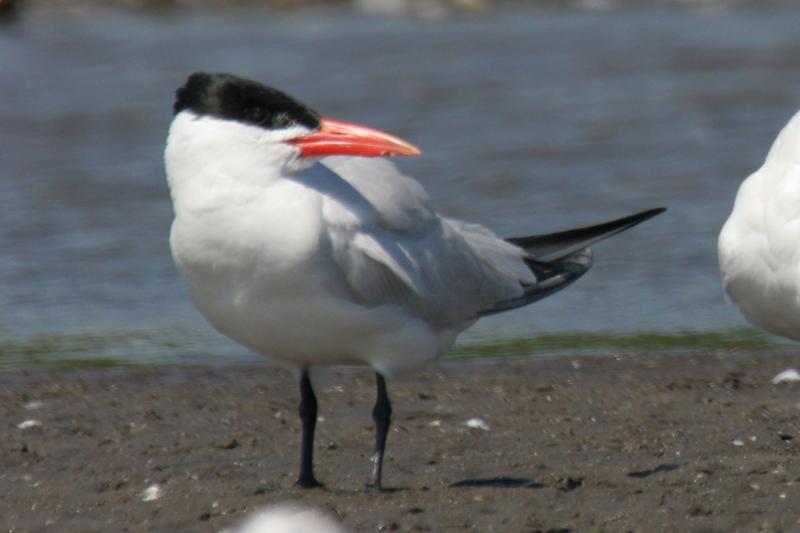
Caspian Tern (Hydroprogne caspia)
Larry Master
- Class
- Aves (Birds)
- Family
- Laridae (Terns, Gulls and Relatives)
- State Protection
- Protected Bird
Defined as a Protected Bird by New York State law, and the species may not be hunted or taken at any time in New York. Includes birds also defined as a game species, but for which no open seasons are set.
- Federal Protection
- Migratory Bird Treaty Act
The Migratory Bird Treaty Act implements various treaties and conventions between the U. S. and Canada, Japan, Mexico and the former Soviet Union for the protection of migratory birds. Under this Act, taking, killing, or possessing migratory birds, including nests or eggs, is unlawful unless specifically permitted by other regulations.
- State Conservation Status Rank
- S1
Critically Imperiled in New York - Especially vulnerable to disappearing from New York due to extreme rarity or other factors; typically 5 or fewer populations or locations in New York, very few individuals, very restricted range, very few remaining acres (or miles of stream), and/or very steep declines.
- Global Conservation Status Rank
- G5
Secure globally - Common in the world; widespread and abundant (but may be rare in some parts of its range).
Summary
Did you know?
Caspian Tern young may begin to vocalize while still in the egg. When an adult gives a Fish Call signaling their return to the nest with food, the soon to be chicks may respond with begging calls before they are even hatched.
State Ranking Justification
The Caspian Tern occurs locally throught its range and has probably never been common or widespread during recorded history. The first known nesting of Caspian Terns in New York occurred in 1986 and the species is therefore recently new to the state. There are only two known colonies statewide. This species is highly susecptible to human disturbance of nesting areas. Although trends indicate that numbers have increased in both New York populations since they were established, scarcity of suitable nesting locations away from predation and human disturbance may be a limiting factor in the state.
Short-term Trends
The Caspian Tern was first confirmed as a breeder in New York in 1986 on Little Galloo Island. The population there has grown from an initial 112 nests reported in 1986 to 1300 nests by 1998 (New York Natural Heritage Program 2008). The maximum number of nests was 1788 in 2005 and has declined to 1376 in 2008 after an outbreak of type E botulism in 2006. A smaller colony of 5 nests was first reported in the second Breeding Bird Atlas in New York on Four Brothers Islands in 2004. The colony has since fluctuated between 34 and 56 nests from 2005 to 2008 (New York Natural Heritage Program 2008).
Long-term Trends
Populations in Europe and Africa have experienced declines over the second half of the 20th century resulting in the species absence or rarity in some parts of its range. However in North America, trends in some parts of their range appear to be increasing. Despite declines in the Great Lakes populations from 1925 to 1960 (Ludwig 1965), numbers since 1960 have tripled (Wires and Cuthbert 2000). Potentially, this is the result of an increase of forage fishes due to the over fishing of large predator fish in the Great Lakes (Wires and Cuthbert 2000). In recent years, North American populations have also expanded their distribution, moving into new areas. The long-term trends of this species are increasing in New York with the first nesting colony ever documented in 1986. Eaton (1910) and Bull (1974) previously only reported the species as a transient or migrant. The first Breeding Bird Atlas reported the species as a probable breeder in the state (Andrle and Carroll 1988), however, the nesting area was not documented until 1986, a year after the atlas field work was complete.
Conservation and Management
Threats
Caspian Terns are sensitive to human disturbance at nest sites especially in the early stages of nesting and incubation (Cuthbert and Wires 1999) and nearby. Well meaning researchers, recreational boaters, and fishermen may, therefore, pose a threat to new or unprotected colonies. Entire colonies have abandoned nesting areas in response to human presence (Cuthbert 1981). Investigator effects occur during research when observers flush birds from the nest inadvertently enabling predators such as gulls access to the nest while the parents are agitated by the intruder. Adults may even abandon chicks due to the presence of researchers, for instance during banding efforts (Penland 1981, Penland 1982). Fetterolf and Blokpoel (1983) used a combination of remote monitoring of tern nesting sites and refrained from visiting nesting areas during the post-hatching period to limit investigator effects on a colony near Toronto on Lake Ontario. They cite this method as a necessity to accurately document fledgling success and concluded that nesting success was greatly increased in years where this method was employed in lieu of more frequent visits (Fetterolf and Blokpoel 1983). The Great Lakes population inhabits remote natural islands and a few sites on the mainland shores of the lakes (Wires and Cuthbert 2000). Since this species is sensitive to human disturbance, development of these or surrounding sites would threaten populations; although both nesting colonies in New York are located on protected islands. Also North American populations have congregated in high densities at a smaller number of nesting sites (Wires and Cuthbert 2000), making the species more vulnerable to stochastic events including disease, weather, and changing environmental conditions. In New York, there are only two known nesting colonies. In 2006, 672 Caspian Terns from the Little Galloo Island population were found dead from type E botulism (W. Stone pers. comm. cited in Smith 2008). Although, the number of nests reported in 2007, 1580, was similar to the number reported before the outbreak in 2006 of 1589 and numbers exhibited only a moderate decline to 1376 nests in 2008 (New York Natural Heritage Program 2008), future outbreaks would be detrimental and could eventually lead to the extirpation of this nesting colony (Smith 2008). Studies in the Great Lakes have also indicated the presence of environmental contaminants particularly PCBs, TCDD, DDE, mirex, and HCB in Caspian Tern eggs and chicks (Grasman et al. 1996, Struger and Weseloh 1985). These are harmful because they may lead to immunosuppression, reproductive and developmental difficulties in birds as well as egg-shell thinness (Grasman et al. 1996, Struger and Weseloh 1985). Despite this, the Great Lakes the population appears to be reproducing and expanding successfully demonstrating some resilience to current contaminant levels.
Conservation Strategies and Management Practices
Since the colonies with highest reproductive success are found in locations isolated from human disturbance with low predation, best management practices are centered around minimizing disturbance to the nesting area. Successful efforts include the creation of nesting islands away from disturbance, limiting human access, and protecting existing colonies from development pressure. Researchers have sought to limit investigator disturbance by implementing nest covers while visiting the nesting area and even constructing tunnels to allow access to observation blinds without distressing the colony. Taylor and Blokpoel (1996) described the successful creation of nesting islands and rafts in Hamilton Harbour in Lake Ontario and the process they used to encourage the occupation of them. Quinn and Sirdevan (1998) demonstrated that Caspian Terns selected sand as a nesting substrate over stone and gravel and recommend mixing sand with a small amount of pea gravel which is used in nest lining, during habitat creation projects. This research, in addition to the creation of floating nesting platforms, proved effective to establish new colonies on Lake Ontario (Quinn and Sirdevan 1998). In New York, both known colonies occupy islands that are protected and managed for colonial waterbirds. Human activity such as boat-landing and fishing surrounding the islands could disturb breeding birds and should be restricted from April through July. Activities that would negatively affect water quality, increase water temperature, turbidity, or alter depths surrounding the islands could impact spawning and reproduction by fish species in the area (NY State Department of State and NY Department of Environmental Conservation 1993).
Research Needs
Research is needed to identify stopover sites during migration and important wintering areas; both remain largely unknown. Other research priorities for this species include population dynamics especially factors that favor increase and expansion, comparative studies of solitary verses colonial nesting behavior, and studies of reproductive strategies and parental care (Cuthbert and Wires 1999). Research into the genetic structure of North American populations, especially given the disjunct distribution and fidelity to the natal site, are warranted (Cuthbert and Wires 1999). In New York, future inventory efforts are needed to identify new nesting locations assuming the continued eastward expansion in distribution.
Habitat
Habitat
In North America, Caspian Terns breed in various types of habitats including estuaries, salt marshes, islands (coastal and freshwater), bays, and beaches. Both nesting colonies in New York are on islands in large lakes. Populations along the Great Lakes typically nest on islands and beaches with a substrate consisting of sand, pebbles, or gravel with very little vegetation. Inland populations tend to nest on the shell banks and sandy, pebbly beaches of islands in rivers or lakes. Coastal populations nest on open, sandy beaches and islands. Caspian Terns have been observed nesting near driftwood, perhaps offering shade or concealment, along shorelines in the above mentioned localities (Bent 1921, Cuthbert and Wires 1999). There are only two known breeding colonies in New York. One is on an island composed of rock located 5.5 miles from the mainland in Lake Ontario. The vegetation on the island consists of grass and weeds with sparse trees around the perimeter and a grassy meadow in the center of the island (Weseloh and Blokpoel 1993). The area where the tern's nested was described in 1986 as a firm substrate of soil and mud with some vegetation such as mustard (Cruciferae) (Weseloh and Blokpoel 1993). It was noted that the island supports a high number of nesting colonial waterbirds and appeared "saturated" with nesting gulls even prior to the tern colonization (Weseloh and Blokpoel 1993). The other nesting location in New York is an island in Lake Champlain that is covered by thick reed canary grass. The terns utilize a 0.25 acre clearing previously created and occupied by comormants (Capen pers. comm.). Caspian Terns have also utilized man-made habitats for nesting. One example is a colony in Ontario, Canada, where three islands were constructed in Hamilton Harbour to replace nesting areas that were slated for development. The islands were built to encourage Caspian Terns to nest there by forming them high enough so that the islands would not get washed over during storms, raised knolls were created, and sand and gravel was laid down as a nesting substrate. The terns successfully colonized the islands the first year they were created (Neuman and Blokpoel 1997). During migration, Caspian Terns are most often seen on large inland marshes, lakes, and rivers. Those that migrate along the Atlantic Flyway use barrier islands, beaches, and wetlands as stopover sites. Wintering areas are similar to migration habitats (Bent 1921, Cuthbert and Wires 1999).
Associated Ecological Communities
- Great Lakes dunes
(guide)
A community dominated by grasses and shrubs that occurs on active and stabilized sand dunes along the shores of the Great Lakes. Unstable dunes are sparsely vegetated, whereas the vegetation of stable dunes is more dense, and can eventually become forested.
- Great Lakes exposed shoal
The aquatic community of the shallow littoral zone of the Great Lakes that occurs along windswept shores that are exposed to wave action, typically associated with islands and points. The lake substrate may be sandy, gravelly, cobbly, bouldery, or with submerged bedrock outcrops.
- Sand beach
A sparsely vegetated community that occurs on unstable sandy shores of large freshwater lakes, where the shore is formed and continually modified by wave action and wind erosion. Characteristic species that are usually present at very low percent cover include various grasses and other herbs.
Associated Species
- Herring Gull (Larus argentatus)
- Ring-billed Gull (Larus delawarensis)
- Great Black-backed Gull (Larus marinus)
- Common Tern (Sterna hirundo) (guide)
Range
New York State Distribution
Only two nesting colonies are known in New York, however, this species exhibits a large home range for foraging which may obscure the locations of other small colonies. Caspian Terns have nested on Little Galloo Island in Lake Ontario since 1986 and on Four Brothers Islands in Lake Champlain since 2004.
Global Distribution
Breeding Range: Caspian Terns occur in a patchy distribution throughout their range. They breed in the eastern U.S. on the Atlantic and Gulf coasts, from northern Florida to Virginia. They also breed in New Jersey, on the central Gulf Coast of Florida, and in southeastern Louisiana, Alabama, Mississippi, and Texas, and around the Great Lakes. In western North America, Caspian Terns breed in a few locations along the coast in Washington, California, Alaska and also also Baja California and in Sinaloa. They breed in the interior of the western United States in Washington, eastern Oregon, northern Utah, northwestern Wyoming, Idaho (recent range expansion), North Dakota, southern California, and western Nevada. In Canada, the terns breed in the central region including the southern northwest territories at Great Slave Lake, northeastern and southern Alberta, southern Saskatchewan, and southern Manitoba. In Canada, they also breed in Labrador, southeastern Quebec, Newfoundland and in and along the Great Lakes in southern Ontario. The breeding distribution also includes populations in Europe, Asia, Africa, and Australia. Winter Range: Caspian Terns overwinter along the Pacific coast from southern California south to Guatemala and along the Atlantic coast from southern North Carolina south around the Florida panhandle along the gulf coast to northern Honduras. They are casual winter resdients in Hawaii and rare in the West Indies. This species also winters in Europe, Asia, Africa, and Australia.
Best Places to See
- Little Gallo Island, eastern Lake Ontario (Jefferson County)
- Four Brothers Island, Lake Champlain
Identification Comments
General Description
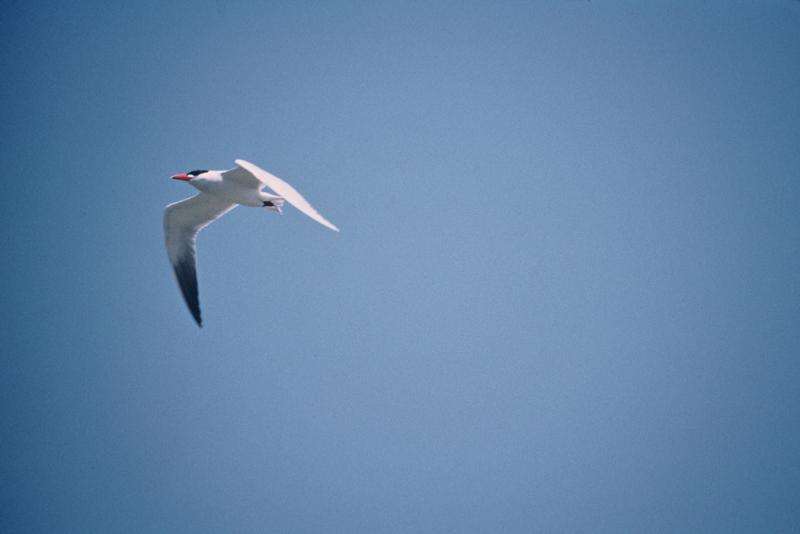
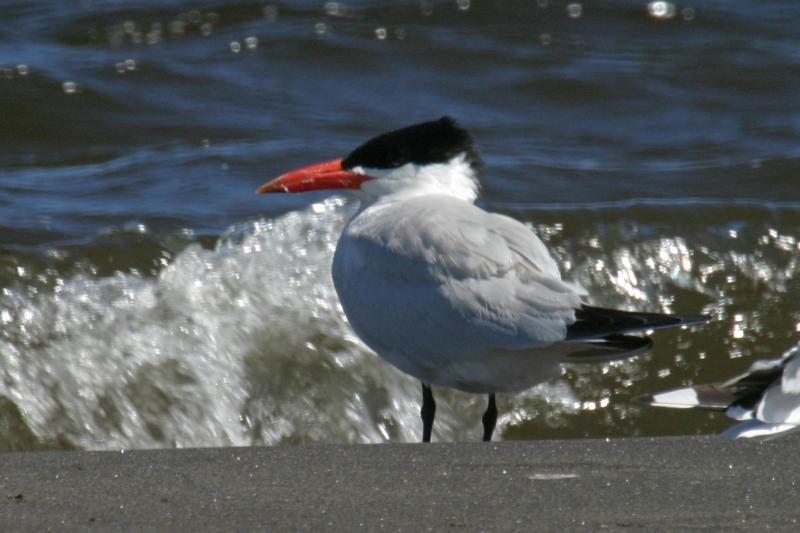
The Caspian Tern is the largest tern species, measuring about 47-54 cm in length and weighing 530-780 grams. They have a thick orange-red bill, black feet, white belly, light gray wings and back, and a slightly forked tail. The tips of the outer primaries (flight feathers) are edged in dark gray, the undersides of the wings have substantial dark grey on the outer primaries, and the adult has a black cap during the breeding season.
Identifying Characteristics
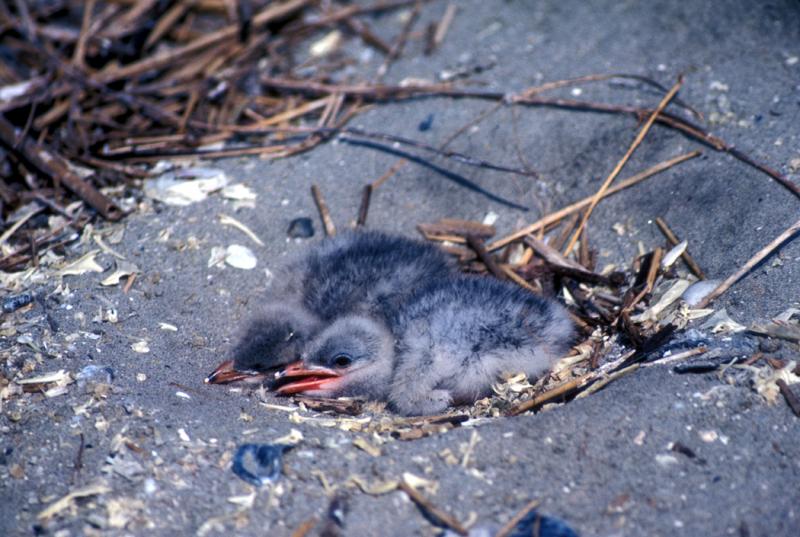
The Caspian Tern is the largest of the tern species. Characteristics consistent in both breeding and nonbreeding plumage include the thick orange-red bill, black feet, white belly, light gray upper side of wings and back, the tips of the outer primaries edged in dark gray, grayish-black underside of the outer primary feathers, and a slightly forked tail. BREEDING PLUMAGE: Adults develop a black cap on the head extending to below the eye and the tail becomes all white. NONBREEDING PLUMAGE: The black cap on the head changes from solid black to black and white streaks, giving it a salt-and-pepper appearance, and the color of the tail feathers change from white to dark gray. JUVENILES: Juveniles resemble adults in nonbreeding plumage except that on juveniles, the cap on the head extends further down the neck, there is a pale ring around the eye, the tops of the primary feathers and primary coverts are edged in white, the tops of the scapular wing feathers and lesser coverts have dark marks near the tips, the tail feathers are white with blackish-gray marks on the ends, and the feet are yellow gradually turning black. HATCHLINGS: Hatchlings are downy, with the upperparts either dark gray or grayish-white and occasionally spotted, the throat is pale gray, and the undersides are white. The bill is pale orange with a black tip. EGGS: Eggs are ovate to elliptical in shape, averaging 65 x 45 mm in size and 50-77 grams in weight. The eggs are semi-rough in texture with many color varieties: light pink buff, pale buff, warm buff, or light buff, and occasionally marked with small dark brown spots or blotches. NEST: The nest site is usually a shallow depression big enough to hold 2-4 eggs, in areas with little to no vegetation, and built on sticks, woody debris, broken shells, or on bare sand. Nest lining consists of dried grass or moss, small rocks, parts of clam shells or other debris. Nests can be edged with oyster shells or crayfish parts. VOCALIZATIONS: Caspian Tern young may begin to vocalize while still in the egg with a Begging Call in response to an adults Fish Call, which advertises an adult returning with food. They may respond to the adult's Alarm Call as well. Hatchlings make an "ee ee" or "i-i-i" Begging Call and as the chicks become older it changes to a loud "uivi" or "uivii" sound. Adults have various types of calls: the Alarm Call is heard when the colony is disturbed and sounds like a loud barking "ra, ra, raeu"; the Contact Call is commonly heard when a tern colony is undisturbed and sounds like "rau" or "rrau"; the Fish Call signals mate-to-mate or parent-to-chick recognition and is heard most often in flight when the male adult is bringing food for the female or chicks, or when adults are signaling chicks to emerge from hiding, sounds like "ra-ra-ra-ratschrau". Other vocalizations include harsh sounds produced when engaging in aggressive behavior towards other terns, the Gakkering Call heard when swooping down on an enemy, and the Female Begging Call, made to signal courtship and feeding from the male. Buzzing sounds are also produced by the wings while diving during courtship flights. (Bent 1921; Cuthbert and Wires 1999; National Geographic 1999)
Characters Most Useful for Identification
The large, gull-like body, thick orange bill, and dark undersides of the outermost primary feathers are characteristics most useful in identifying Caspian Terns.
Best Life Stage for Proper Identification
Adult Caspian Terns in breeding plumage are the easiest to identify.
Behavior
Caspian Terns are considered to be the loudest and most aggressive tern species, especially when defending their territories during the breeding season. Caspian Terns defend a small, circular territory surrounding the nest site (Cuthbert and Wires 1999). They are colonial nesters, nesting with other Caspian Terns and sometimes near other colonial waterbird colonies. Pair bonds are usually formed before arrival to the breeding grounds, and pairs uaually remain together throughout the breeding season. Nests are built a few days after arrival, with the first egg laid soon after. Typical clutches consist of two to four eggs. In some colonies throughout the breeding range, there have been observations of "supernormal clutches" in which there are five or more eggs in a nest, resulting from eggs of two females laid in one nest or eggs being aggregated together after nest abandonment or partial destruction. These nests have been observed to be attended to by female-female pairs. It is unclear how the female-female pair-bond is formed (Conover 1983; Penland 1984). There is usually one brood per season, unless the first nest fails due to predation or environmental factors, then they will renest. Incubation lasts a little over three weeks with both parents tending to the nest. Once the chicks hatch, they are dependant on their parents for five to seven months, even though they are capable of flying and catching food on their own, and are accompanied by a parent during winter migration. Feeding typically takes place during the early morning and the rest of the day is spent loafing (Bent 1921; Neuman and Blokpoel 1997; Cuthbert and Wires 1999).
Diet
Caspian Terns feed mainly on fish, occasionally feeding on crayfish and small insects. Species of fish vary geographically. In northeast and Great Lakes populations, fish species include alewife, rainbow smelt, yellow perch, and rock bass. Fishing usually takes place along or near shorelines, typically no less than 100 m away from the shore. Once a fish is spotted, Caspian Terns dive and wholly submerge if fishing over deep water, then resurface after a few seconds, and fly back to land, usually swallowing the fish during flight (Cuthbert and Wires 1999). There have been observations of Caspian Terns robbing other species of terns and gulls of food, and an unusual observation of feeding on carrion (Cunningham 1966).
Best Time to See
Caspian Terns that breed in the northeast and Great Lakes region begin arriving at their breeding grounds soon after ice break-up, usually in April. Peak nesting occurs late May to mid June, with chicks hatching in July to early August. Adults and young begin to migrate to wintering grounds mid to late August and are at their wintering areas by mid-November. They are most often seen during spring and fall migration (Cuthbert and Wires 1999; Smith 2008).
- Active
- Reproducing
The time of year you would expect to find Caspian Tern active and reproducing in New York.
Similar Species
- Royal Tern (Thalasseus maximus)
The bill of the Royal Tern is not as thick as that of the Caspian Tern, the tail is deeply forked, and the undersides of the outermost primary feathers are mostly white, as compared to the shallow forking of the tail and dark underside of the outermost primary feathers of the Caspian Tern. In nonbreeding plumage, the black and white-streaked cap of the Royal Tern does not extend below the eye, and the forehead is mostly white. Royal Terns do not nest in New York (National Geographic 1999).
Caspian Tern Images
Larry Master
Lee Karney
Donna A. Dewhurst
Larry Master
Taxonomy
Caspian Tern
Hydroprogne caspia (Pallas, 1770)
- Kingdom Animalia
- Phylum Craniata
- Class Aves
(Birds)
- Order Charadriiformes
(Gulls, Plovers, and Shorebirds)
- Family Laridae (Terns, Gulls and Relatives)
- Order Charadriiformes
(Gulls, Plovers, and Shorebirds)
- Class Aves
(Birds)
- Phylum Craniata
Synonyms
- Sterna caspia Pallas, 1770
Additional Resources
References
American Ornithologists' Union (AOU). 1983. Check-list of North American Birds, 6th edition. Allen Press, Inc., Lawrence, Kansas. 877 pp.
American Ornithologists' Union (AOU). 2006. Forty-seventh supplement to the American Ornithologists' Union Check-list of North American Birds. The Auk 123(3):1926-936.
Bent, A.C. 1921. Life histories of North American gulls and terns. U.S. Natl. Mus. Bull. 113. Washington, D.C.
Buckley, P. A., and F. G. Buckley. 1984. Seabirds of the north and middle Atlantic coast of the United States: their status and conservation. Pages 101-133 in Croxall et al., eds. Status and conservation of the world's seabirds. ICBP Tech. Pub. No. 2.
Bull, John. 1974. Birds of New York State. Doubleday, Garden City, New York. 655 pp.
Conover, Michael. 1983. Female-female pairings in Caspian Terns. Condor 85:346-349.
Cunningham, R. L. 1966. Caspian Tern feeding upon carrion. Wilson Bulletin 78:319.
Cuthbert, F. J. 1981. Caspian Tern colonies in the Great Lakes: responses to an unpredictable environment. Ph.D. thesis, University of Minnesota, Minneapolis.
Cuthbert, F. J. 1985. Mate retention in Caspian terns. Condor 87:74-78.
Cuthbert, F. J. 1988. Reproductive success and colony-site tenacity in Caspian terns. Auk 105:339-344.
Cuthbert, F. J., and L. R. Wires. 1999. Caspian Tern (STERNA CASPIA). No. 403 IN A. Poole and F. Gill, editors. The birds of North America. The Birds of North America, Inc., Philadelphia, PA. 32pp.
Eaton, E.H. 1910. Birds of New York. Part 1. New York: University of State of New York. Albany, NY.
Evans, P. G. H. 1984b. Status and conservation of seabirds in northwest Europe (excluding Norways and the USSR). Pages 293-321 in Croxall et al., eds. Status and conservation of the world's seabirds. ICBP Tech. Pub. No. 2.
Fetterolf, P. M. and H. Blokpoel. 1983. Reproductive performance of Caspian Terns at a new colony on Lake Ontario, 1979-1981. Journal of Field Ornithology 54(2):170-186.
Gill, R. E., Jr. 1976. Notes on the foraging of nesting Caspian terns, HYDROPROGNE CASPIA (Pallas). California Fish and Game 62:155.
Gill, R. E., Jr., and L. R. Mewaldt. 1983. Pacific coast Caspian terns: dynamics of an expanding population. Auk 100:369-381.
Grasman, K.A., G.A. Fox, P.F. Scanlon, and J.P. Ludwig. 1996. Organochlorine-associated immunosuppression in prefledgling Caspian Terns and Herring Gulls from the Great Lakes: An ecoepidemiological study. Environmenal Health Perspectives 104(4):829-842.
Harrison, C. 1978. A Field Guide to the Nests, Eggs and Nestlings of North American Birds. Collins, Cleveland, Ohio.
Hyslop, C., and J. Kennedy, editors. 1992. Bird trends: a report on results of national ornithological surveys in Canada. Number 2, Autumn 1992. Migratory Birds Conservation Division, Canadian Wildlife Service, Ottawa, Ontario. 20 pp.
Kress, S. W., E. H. Weinstein, and I. C. T. Nisbet. 1983. The status of tern populations in the northeastern United States and adjacent Canada. Colonial Waterbirds 6:84-106.
Ludwig, J. P. 1965. Biology and structure of the Caspian Tern (Hydroprogne caspia) population of the Great Lakes from 1896 - 1964. Bird-Banding 36(4):217-233.
National Geographic Society (NGS). 1999. Field guide to the birds of North America. Third edition. National Geographic Society, Washington, DC. 480 pp.
Neuman, J. and H. Blokpoel. 1997. Great Lakes fact sheet: The terns of the Canadian Great Lakes. Canadian Wildlife Service.
New York Natural Heritage Program. 2008. Biotics Database. Albany, NY.
New York Natural Heritage Program. 2024. New York Natural Heritage Program Databases. Albany, NY.
New York State Breeding Bird Atlas. 1985. Final breeding bird distribution maps, 1980-1985. New York State Department of Environmental Conservation, Wildlife Resources Center. Delmar, NY.
New York State Department of Environmental Conservation. 1986. New York State Breeding Bird Atlas Database. Wildlife Resources Center. Delmar, NY.
New York State Department of Environmental Conservation. Checklist of the amphibians, reptiles, birds, and mammals of New York State, including their protective status. Nongame Unit, Wildlife Resources Center, Delmar, NY.
New York State Department of State and New York Department of Environmental Conservation. 1993. Coastal Fish and Wildlife Habitat Rating Form Little Galloo Island. Online. Available: http://www.nyswaterfronts.com/downloads/pdfs/sig_hab/GreatLakes/Little_Galloo_Island.pdf
Penland, S. 1981. Natural history of the Caspian Tern in Grays Harbor, Washington. Murrelet 62:66-72.
Penland, S. 1982. Distribution and status of the Caspian Tern in Washington state. Murrelet 63:73-79.
Penland, S. T. 1984. An alternative origin of supernormal clutches in Caspian Terns. Condor 86:496.
Quinn, J. S. 1984. Egg predation reduced by nest covers during research activities in a Caspian tern colony. Colonial Waterbirds 7:149-151.
Quinn, J. S. and J. Sirdevan. 1998. Experimental measurement of nesting substrate preference in Caspian Terns, Sterna caspia, and the successful colonization of human constructed islands. Biological Conservation 85:63-68.
Shugart, G.W., M.A. Fitch, and V.M. Shugart. 1981. Minimizing investigator disturbance in observational studies of colonial waterbirds: Access to blind through tunnels. Wilson Bulletin 93:565-569.
Smith, G. 2008. Caspian Tern Hydroprogne caspia. In K. McGowan and K. Corwin (Eds.) The atlas of breeding birds in New York State: 2000-2005. Cornell University Press, Ithaca, NY.
Smith, G. A. 1987d. A selected and annotated bibliography for use in management of the Caspian tern (Sterna caspia). New York Dept. Environ. Conserv., Delmar, New York. 29 pp.
Spendelow, J. A. and S. R. Patton. 1988. National Atlas of Coastal Waterbird Colonies in the Contiguous United States: 1976-1982. U.S. Fish and Wildlife Service, Biological Report 88(5). x + 326 pp.
Struger J. and D. V. Weseloh. 1985. Great Lakes Caspian Terns: egg contaminants and biological implications. Colonial Waterbirds 8(2): 142-149.
Terres, J. K. 1980. The Audubon Society encyclopedia of North American birds. Alfred A. Knopf, New York.
Weseloh, D.V.C. and H. Blokpoel. 1993. Caspian Tern nesting at Little Galloo Island: a new nesting species for New York State. The Kingbird 43(1):6-12.
Wires L.R., and F.J. Cuthbert. 2000. Trends in Caspian Tern numbers and distribution in North America: A review. Waterbirds 23(3): 388-404.
Links
About This Guide
Information for this guide was last updated on: July 22, 2009
Please cite this page as:
New York Natural Heritage Program. 2024.
Online Conservation Guide for
Hydroprogne caspia.
Available from: https://guides.nynhp.org/caspian-tern/.
Accessed April 24, 2024.