Gull-billed Tern
Gelochelidon nilotica (Gmelin, 1789)
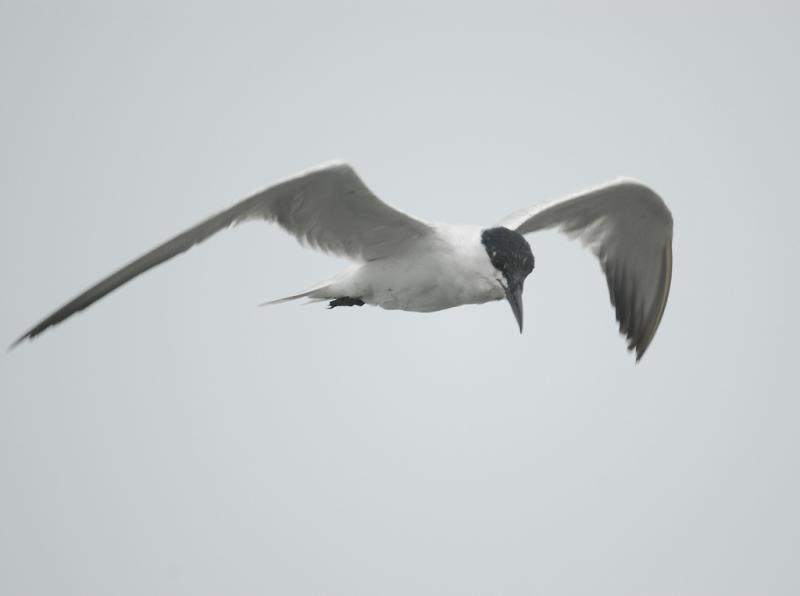
Gull-billed Tern
Changhua Coast Conservation Action (TWSG)
- Class
- Aves (Birds)
- Family
- Laridae (Terns, Gulls and Relatives)
- State Protection
- Protected Bird
Defined as a Protected Bird by New York State law, and the species may not be hunted or taken at any time in New York. Includes birds also defined as a game species, but for which no open seasons are set.
- Federal Protection
- Migratory Bird Treaty Act
The Migratory Bird Treaty Act implements various treaties and conventions between the U. S. and Canada, Japan, Mexico and the former Soviet Union for the protection of migratory birds. Under this Act, taking, killing, or possessing migratory birds, including nests or eggs, is unlawful unless specifically permitted by other regulations.
- State Conservation Status Rank
- S1
Critically Imperiled in New York - Especially vulnerable to disappearing from New York due to extreme rarity or other factors; typically 5 or fewer populations or locations in New York, very few individuals, very restricted range, very few remaining acres (or miles of stream), and/or very steep declines.
- Global Conservation Status Rank
- G5
Secure globally - Common in the world; widespread and abundant (but may be rare in some parts of its range).
Summary
Did you know?
Gull-billed Terns are very rare in New York and are known currently from only five saltmarsh islands off the south shore of Long Island in Nassau County.
State Ranking Justification
Gull-billed Terns are at the northern extent of their range in New York and their statewide distribution is highly restricted. They are known to breed on only five marsh islands off the south coast of Long Island in Nassau County. They are threatened by habitat loss and human disturbance. Their coastal salt marsh habitat is threatened by changes to hydrological processes due to coastal development and by sea-level rise and increasing storms due to global climate change. This species is especially sensitive to human activity near nesting locations (Molina et al. 2009).
Short-term Trends
This species is so rare in New York that it is difficult to compare distribution over a limited time period. Gull-billed Terns were found in three blocks in the first Breeding Bird Atlas from 1980 to 1985 and in five in the second atlas from 2000 to 2005 (McGowan and Corwin 2008). During both atlases the species was restricted to the south shore of Long Island in Nassau County, with one record from the first atlas from nearby southwestern Suffolk County (McGowan and Corwin 2008).
Long-term Trends
Gull-billed Terns have likely always been a rare and local breeder in the state. The long-term trends are unclear. A few specimens were taken in the 1880s during the breeding season from sites where breeding is presently known or suspected (Griscom 1923, Bull 1964, McGowan and Corwin 2008). The species was likely extirpated from the state for an unknown extent of time soon after those specimens were taken (Griscom 1923, McGowan and Corwin 2008). There are only sporadic records; some associated with hurricanes during migration in the fall from 1934 to 1975 (Cruickshank 1942, McGowan and Corwin 2008). Breeding was confirmed in the state in 1975 by the discovery of a pair with a nest with eggs on South Line Island in Nassau County (Levine 1998).
Conservation and Management
Threats
Although Gull-billed Terns don't occur in large numbers in New York, populations may be threatened by habitat loss and human disturbance. A combination of factors may contribute to the dramatic declines of coastal salt marsh, that Gull-billed terns use for both nesting and foraging, on Long Island over the last 50 years (Hartig 2002). Changes to hydrologic processes resulting from coastal developement coupled with increases in sedimentary sulfide associated with human development are also believed to play primary roles in the decline of coastal salt marsh (Montalto and Steenhuis 2004, Kolker 2005). Sea-level rise and increased storms and flooding due to global climate change ia also a threat. Gull-billed Terns are particularly sensitive to disturbance and may abandon nests more readily than other tern species (Molina et al. 2009). Recreational boaters driving at high speeds or anchoring near salt marsh islands may disrupt terns from parental care of eggs and chicks leaving them vulnerable to predation. If colonies were to reestablish on beaches in New York they may be restricted by available habitat that is undeveloped and free of disturbance from recreational beachgoers and beach driving.
Conservation Strategies and Management Practices
Management for Gull-billed Terns requires both the protection of existing colonies to enable populations to perpetuate and grow, and the restoration and protection of habitat for terns to move into as populations expand or disturbed colonies need to relocate. Discouraging gull colonies at some locations may be necessary to reestablish previous nesting locations and can be done through a variety of methods including establishing a monofilament grid over the area, culling, or disturbance by dogs (Kress et al. 1983, Kress 1997, Nisbet 2002, Blokpoel et al. 1997). Managing predators may be effective in certain circumstances where nest predation is high (Molina et al. 2010). Maintaining and protecting habitat at a number of suitable nesting locations is ideal even if some sites are temporarily unoccupied to allow colonies to relocate when disturbance occurs. Posting educational signs just prior to the nesting season has been an effective method at limiting human disturbance to colonies of other tern species on beaches (Burger 1989).
Research Needs
At a minimum, continued monitoring of known nesting locations in New York and inventory of past and potential nesting locations is needed. Information on reproductive success in addition to the population index counts that are conducted annually by NY DEC would be useful to determine trends in productivity. If breeding success is deemed to be low, then threats to individual colonies may be identified and management actions can be taken if needed. Migration routes, stopover locations, and overwintering sites need to be determined especially along the Pacific and Mexican coasts (Molina et al. 2009). More research and monitoring of environmental toxin loads, genetic research on subspecies distributions, and dermining productivity of roof nests in the southeastern U.S. are also priorities (Molina et al. 2009).
Habitat
Habitat
Historical habitat in New York is unclear due to lack of historical nesting descriptions in the state. Bent (1921) called this species the "marsh tern" because it nested along marshes and fed over them (Molina et al. 2009). However, most colonies along both the Atlantic and Gulf coasts nest on sandy beaches, barrier islands, or dredge spoils and often occur near ocean inlets (Portnoy 1977, Chaney et al. 1978, Schreiber and Schreiber 1978, Parnell and Soots 1979, Molina et al. 2009). In New York, Gull-billed Tern nests have been found on dredge spoil islands within bays and marshes and on barrier beaches (McGowan and Corwin 2008). The one barrier beach location previously known from New York has been abandoned and all currently known breeding locations are on bay islands consisting of marsh.
Associated Ecological Communities
- Brackish interdunal swales
(guide)
Temporarily tidally flooded temperate marshes in interdunal swales dominated by salt-tolerant graminoids. Individual swales occur as small patches positioned between fore-, primary and secondary dunes in a maritime dunes system, typically on barrier islands.
- High salt marsh
(guide)
A coastal marsh community that occurs in sheltered areas of the seacoast, in a zone extending from mean high tide up to the limit of spring tides. It is periodically flooded by spring tides and flood tides. High salt marshes typically consist of a mosaic of patches that are mostly dominated by a single graminoid species.
- Low salt marsh
(guide)
A coastal marsh community that occurs in sheltered areas of the seacoast, in a zone extending from mean high tide down to mean sea level or to about 2 m (6 ft) below mean high tide. It is regularly flooded by semidiurnal tides. The mean tidal range of low salt marshes on Long Island is about 80 cm, and they often form in basins with a depth of 1.6 m or greater.
- Maritime beach*
(guide)
A community with extremely sparse vegetation that occurs on unstable sand, gravel, or cobble ocean shores above mean high tide, where the shore is modified by storm waves and wind erosion.
- Maritime dunes*
(guide)
A community dominated by grasses and low shrubs that occurs on active and stabilized dunes along the Atlantic coast. The composition and structure of the vegetation is variable depending on stability of the dunes, amounts of sand deposition and erosion, and distance from the ocean.
- Salt panne
(guide)
A shallow depression in a salt marsh where the marsh is poorly drained. Pannes occur in both low and high salt marshes. Pannes in low salt marshes usually lack vegetation, and the substrate is a soft, silty mud. Pannes in a high salt marsh are irregularly flooded by spring tides or flood tides, but the water does not drain into tidal creeks. After a panne has been flooded the standing water evaporates and the salinity of the soil water is raised well above the salinity of sea-water.
* probable association but not confirmed.
Associated Species
Range
New York State Distribution
New York is at the northern extent of the Gull-billed Tern's range and its statewide distribution is highly restricted. They are currently only known during the breeding season in small numbers from five locations off the south shore of Long Island in Nassau county and previously in southwestern Suffolk County (Levine 1998, McGowan and Corwin 2008, NYSDEC 2011). The known recent breeding locations include East Channel Islands, Cinder Islands group, Garrett marsh, Long Meadow Island, and an island off of Big Hassock (McGowan and Corwin 2008, NYSDEC 2011). The species doesn't spend the winter in New York (see Global Distribution).
Global Distribution
BREEDING: The breeding range of the Gull-billed Tern includes southern California (San Diego Bay, Salton Sea), the western coast of Mexico (Sonora, Sinaloa, Baja California, Gulf of California), the Atlantic and Gulf coasts of North America from New York (Long Island; scarce north of Maryland) south to Florida and west to southern Texas (also inland); and probably also in Tamaulipas and Veracruz in eastern Mexico, the Bahamas, and Virgin Islands (Anegada, probably Sombrero, formerly Cockroach Bay); in South America (southwestern Ecuador, and from central Brazil south to northern Argentina); and in the Old World from northern Europe, central Russia, southern Mongolia, and eastern China south to northwestern Africa, Asia Minor, Iran, India, Sri Lanka, and southern China; and in Australia (Sprunt 1954, AOU 1998, Molina et al. 2009). NONBREEDING: The nonbreeding range in the Americas includes coastal areas from Nayarit, the Gulf Coast, and southern Florida south through Middle America and the West Indies to Peru and northern Argentina (AOU 1998). In the Old World, the nonbreeding range extends from tropical Africa, Persian Gulf, India, Southeast Asia, eastern China, and the Philippines south to southern Africa, Java, and Borneo; also Australia and Tasmania (AOU 1998).
Best Places to See
- Fire Island Inlet (Suffolk County)
- Hempstead Bay (Nassau County)
- Jones Beach (Nassau County)
- Jamaica Bay (Queens County)
Identification Comments
General Description
The Gull-billed Tern is a medium-sized tern. Adults in breeding plumage display a stout black bill, black legs, black cap, and light grey back.
Identifying Characteristics
Gull-billed Terns are stout, white, blunt-billed birds that feed in marshes and adjacent coastal uplands (Forbush 1939, Harrison 1983, Cramp 1985). They are similar in size to other medium-sized terns. Their flight is usually more buoyant and gull-like than that of other terns (Vinicombe and Harris 1989). While in breeding plumage, a black cap extends from the feathers between the eye and bill, around the eyes, to the nape. The rest of the upper parts, wings, and tail are pale gray. The side of the head, underparts, and wing linings are white. The long flight feathers that extend along the outer edge of the wings and that form the lower border of the folded wing (primaries) are grayish-black underneath and frosty-gray above. The legs and feet are black. The heavy black bill lacks the sharp tip of other terns and is stouter and proportionately shorter. The sexes are similar in appearance. Winter plumage is similar to the breeding plumage except that the black cap is nearly absent, with only some remnant spotting near the rear of the crown. A blackish patch extends from the eye to the feathers covering the ears (auriculars), although the extent of this is quite variable (Harrison 1983, Cramp 1985). Recently fledged juveniles are similar to adults in winter plumage except that the head is darker with more blackish spots and the gray back and upper wing are edged in tan, giving the back and wings a buff-colored appearance when the bird is in flight. The downy young are variable in appearance but generally cream, buff, or peach-colored, with darker down on the dorsal surfaces. Young usually have two dorsal stripes on the crown, nape, and back, and a distinctive dark smudge behind the eye. The bill is typically light pink at hatching and darkens with age. The feet are light pink and darken to an orange-brown with age (Harrison 1983, Cramp 1985). The typical call is a nasal "tee-hee-hee" or "kat-y-did" (Bent 1921). Terns attacking terrestrial predators will frequently utter a harsh "grack" call during defensive dives (Sears 1981). Nests can be scraped in sandy barrier beaches and dunes above the high tide line, shell bars or banks, or saltmarsh islands (Bent 1921). The eggs are cryptically colored. The background color may vary from buff to olive, and the mottling is somewhat finer grained than the pattern of the Common Tern (Sterna hirundo) egg. The eggs also have a characteristic "frosty" appearance which also distinguishes Gull-billed Tern eggs from those of the Common Tern (Bent 1921, Harrison 1975).
Characters Most Useful for Identification
The Gull-billed Tern is a medium-sized tern with a stout black bill, black cap, black legs, and a light grey back. The thick black bill distinguishes this species from other terns.
Best Life Stage for Proper Identification
Adults in breeding plumage are easiest to identify but juveniles and birds in their winter plumage can also be distinguised from other tern species.
Behavior
Gull-billed Terns nest in colonies usually among other terns or Black Skimmers. They are essentially monogamous and form long-term pair bonds (Moller 1981). See Sears (1981) for a description of the aerial and ground displays Gull-billed Terns enact during pair bonding, courtship, and before and after copulation. They also have an array of threat displays which may include opening their bill in a gape at the intruder, extending neck outward and abducting wings, or tossing their head back and forth. See Sears (1981), Cramp (1985) and Molina et al. (2009) for further description. They aggressively defend colonies from nest predators and may dive and threaten much larger predatory birds that approach their colonies such as egrets and herons (Molina et al. 2009). Once eggs are laid, both the male and female incubate them. One study in California documented roughly equal incubation times by the male and female (Molina 1999). Young are precocial, meaning they are fully developed and mobile at hatching. Gull-billed Tern chicks, do however, rely on their parents for food. Both parents feed and brood the young; the female feeds them more often (Molina et al. 2009, Lind 1963).
Diet
The Gull-billed Tern's diet mostly consists of a variety of marine and terrestrial insects. In addition, they eat other invertebrates, small vertebrates, and the eggs and young of other birds. Major dietary items include arthropods, locusts, grasshoppers, dragonflies, insects, spiders, and marine life such as fiddler crabs, crustaceans, crabs, and sand bugs (Wilson 1840, Bent 1921, Sprunt 1954, Rohwer and Woolfenden 1968, Cramp 1985, Quinn and Wiggins 1990). Vertebrate fauna consumed include fish, frogs, toads, lizards, and small mammals (Bent 1921, Dement'ev and Gladkov 1951, Bannerman 1962). They are occasionally opportunistic predators on the downy chicks of other beach-nesting birds (Densmore 1990, Molina et al. 2009).
Best Time to See
Gull-billed Terns generally occur on Long Island from mid-May through August or into early September. Extreme dates are May 2 and September 17 (Levine 1998).
- Active
- Reproducing
The time of year you would expect to find Gull-billed Tern active and reproducing in New York.
Similar Species
- Roseate Tern (Sterna dougallii)
(guide)
The adult Roseate Tern in breeding plumage has orange legs and orange at the base of the bill, a thinner bill and a much longer, deeply forked tail.
- Forster's Tern (Sterna forsteri)
(guide)
The adult Forster's Tern in breeding plumage has orange legs and orange at the base of the bill, a thinner bill, and a much longer, deeply forked tail.
- Common Tern (Sterna hirundo)
(guide)
The adult Common Tern in breeding plumage has a mostly orange bill that is thinner than the Gull-Billed Tern's bill, orange legs and has a darker grey back.
Gull-billed Tern Images
Changhua Coast Conservation Action (TWSG)
Taxonomy
Gull-billed Tern
Gelochelidon nilotica (Gmelin, 1789)
- Kingdom Animalia
- Phylum Craniata
- Class Aves
(Birds)
- Order Charadriiformes
(Gulls, Plovers, and Shorebirds)
- Family Laridae (Terns, Gulls and Relatives)
- Order Charadriiformes
(Gulls, Plovers, and Shorebirds)
- Class Aves
(Birds)
- Phylum Craniata
Synonyms
- Sterna nilotica Gmelin, 1789
Additional Resources
References
American Ornithologists' Union. 1998. Check-list of North American Birds, 7th edition. American Ornithologists' Union, Washington, D.C.
Bannerman, D.A. 1962. The birds of the British Isles. Vol. II. Oliver and Boyd, Edinburgh, Scotland.
Bent, A.C. 1921. Life histories of North American gulls and terns. U.S. Natl. Mus. Bull. 113. Washington, D.C.
Blokpoel, H., G. D. Tessier, and R. A. B. Andress. 1997. Successful restoration of the Ice Island Common Tern colony requires ongoing control of Ring-billed Gulls. Colon. Waterbirds 20:98-101.
Bull, John. 1964. Birds of the New York area. New York: Harper and Row Publications 540 pp.
Bull, John. 1974. Birds of New York State. Doubleday, Garden City, New York. 655 pp.
Bull, John. 1976. supplement to birds of New York State. Special publ. of Federation of New York State Bird Clubs. 52 pp.
Burger, J. 1989. Least Tern populations in coastal New Jersey: monitoring and management of a regionally-endangered species. Journal of Coastal Research 5:801-811.
Chaney, A. H., B. R. Chapman, J. P. Karges, D. A. Nelson, R. R. Schmidt, and L. C. Thebeau. 1978. Use of dredged material islands by colonial seabirds and wading birds in Texas. Tech. Rep. D-78-8. U.S. Army Engineer Waterways Exp. Stn. Vicksburg, MS.
Cramp, S. 1985. Handbook of the birds of Europe, the Middle East, and North Africa: the birds of the western Palearctic. Vol. 4. Oxford Univ. Press, Oxford, UK.
Cruickshank, A.D. 1942. Birds around New York City. American Museum of Natural History Handbook Series no. 13. New York.
Dement'Ev, G. P. and N. A. Gladkov. 1951. Birds of the Soviet Union. Vol. 3. (1969 translation from Russian). Israel Progr. Sci. Trans. Jerusalem.
Densmore, R. J. 1990. Gull-billed Tern predation on a Least Tern chick. Wilson Bull. 102:180-181.
Forbush, E.H. 1939. Natural history of the birds of eastern and central North America. Revised and abridged by J.B. May. Houghton Mifflin, Boston, M.A.
Griscom, L. 1923. Birds of the New York City region. American Museum of Natural History, Handbook Series No. 9, New York, New York. 400 pp.
Harrison, C. 1978. A Field Guide to the Nests, Eggs and Nestlings of North American Birds. Collins, Cleveland, Ohio.
Harrison, H. H. 1979. A field guide to western birds' nests. Houghton Mifflin Company, Boston. 279 pp.
Harrison, H.H. 1975. A field guide to birds' nests of 285 species found breeding in the United States east of the Mississippi River. Houghton Mifflin Co., Boston.
Harrison, P. 1983. Seabirds: an identification guide. Houghton Mifflin, Boston.
Hartig E.K., V. Gornitz, A. Kolker, F. Mushacke, and D. Fallon. 2002. Anthropogenic and climate-change impacts on salt marshes of Jamaica Bay, New York City. Wetlands. 22(1):71-89.
Kolker, A.S. 2005. The impacts of climate variability and anthropogenic activities on salt marsh accretion and loss on Long Island. Dissertation. State University of New York at Stony Brook. 759 pp.
Kress, S. W. 1997. Using animal behavior for conservation: case studies in seabird restoration from the Maine coast, USA. J. Yamashina Inst. Ornithol. 29:1-26.
Kress, S. W., E. H. Weinstein, and I. C. T. Nisbet. 1983. The status of tern populations in northeastern United States and adjacent Canada. Colon. Waterbirds 6:84-106.
Levine, E. 1998. Bull's birds of New York State. Comstock Publishing Associates, Ithaca, NY.
Lind, H. 1963. The reproductive behavior of the Gull-billed Tern, Sterna nilotica. Vidensk. Medd. Dansk Naturhist. Foren. 125:407-448.
McGowan, K.J. and K. Corwin, eds. 2008. The Second Atlas of Breeding Birds in New York State: 2000-2005. Cornell University Press, Ithaca, NY. 688 pp.
Molina, K. C. 1999. An evaluation of parental investment hypotheses using Gull-billed Terns and Black Skimmers (Aves: Laridae) at the Salton Sea, California. M.S. thesis. California State University, Northridge.
Molina, K. C., J. F. Parnell and R. M. Erwin. 2009. Gull-billed Tern (Gelochelidon nilotica), The Birds of North America Online (A. Poole, Ed.). Ithaca: Cornell Lab of Ornithology; Retrieved from the Birds of North America Online: http://bna.birds.cornell.edu/bna/species/140.
Molina, K.C., R. M. Erwin, E. Palacios, E. Mellink, and N. Seto. 2010. Status Review and Conservation Recommendations for the Gull-billed Tern (Gelochelidon nilotica) in North America. Biological Technical Publication BTP-R1013-2010. U.S. Fish and Wildlife Service
Montalto, F.A., and T.S. Steenhuis. 2004. The link between hydrology and restoration of tidal marshes in the New York/ New Jersey estuary. Wetlands 24:414-425.
Møller, A. P. 1981. Breeding cycle of the Gull-billed Tern (Gelochelidon nilotica) especially in relation to colony size. Ardea 69:193-198.
New York Natural Heritage Program. 2011. Biotics database. New York Natural Heritage Program. New York State Department of Environmental Conservation. Albany, NY.
New York Natural Heritage Program. 2024. New York Natural Heritage Program Databases. Albany, NY.
New York State Breeding Bird Atlas. 1984. Preliminary species distribution maps, 1980-1984. New York State Department of Environmental Conservation, Wildlife Resources Center. Delmar, NY.
New York State Breeding Bird Atlas. 1985. Final breeding bird distribution maps, 1980-1985. New York State Department of Environmental Conservation, Wildlife Resources Center. Delmar, NY.
New York State Department of Environmental Conservation. Checklist of the amphibians, reptiles, birds, and mammals of New York State, including their protective status. Nongame Unit, Wildlife Resources Center, Delmar, NY.
Nisbet, Ian C. 2002. Common Tern (Sterna hirundo), The Birds of North America Online (A. Poole, Ed.). Ithaca: Cornell Lab of Ornithology; Retrieved from the Birds of North America Online: http://bna.birds.cornell.edu/bna/species/618.
Parnell, J. F. and R. F. Soots, Jr. 1979. Atlas of colonial waterbirds of North Carolina estuaries. UNC-SG-78-10, North Carolina State University, UNC Sea Grant, Raleigh, NC.
Portnoy, J. W. 1977. Nesting colonies of seabirds and wading birds-coastal Louisiana, Mississippi, and Alabama. FWS/OBS-77/07, U.S. Fish and Wildl. Serv. Biol. Serv. Progr. Washington, D.C.
Quinn, J. S. and D. A. Wiggins. 1990. Differences in prey delivered to chicks by individual Gull-billed Terns. Colonial Waterbirds 13(1):67-69.
Rohwer, S. A. and G. E. Woolfenden. 1968. The varied diet of the Gull-billed Tern (Gelochelidon nilotica). Wilson Bull. 80:330-331.
Schreiber, R. W. and E. A. Schreiber. 1978. Succession on dredged material islands in Florida. Report D-78-14. U.S. Army Engineer Waterways Exp. Stn. Vicksburg, MS.
Sears, H. F. 1981. The display behavior of the Gull-billed Tern. J. Field Ornithol. 52:191-209.
Sprunt, A., Jr. 1954. Florida Bird Life. National Audubon Society and Coward-McCann, Inc., New York, New York. 527 pp.
Vinicombe, H. E., and A. Harris. 1989. Field identification of gull-billed tern. British Birds 82:3-13.
Wilson, A. 1840. Wilson's American ornithology (revised by T. M. Brewer). Otis, Broaders, and Co. Boston.
Links
About This Guide
This guide was authored by: Kelly A. Perkins
Information for this guide was last updated on: June 17, 2011
Please cite this page as:
New York Natural Heritage Program. 2024.
Online Conservation Guide for
Gelochelidon nilotica.
Available from: https://guides.nynhp.org/gull-billed-tern/.
Accessed April 24, 2024.