Least Bittern
Ixobrychus exilis (Gmelin, 1789)
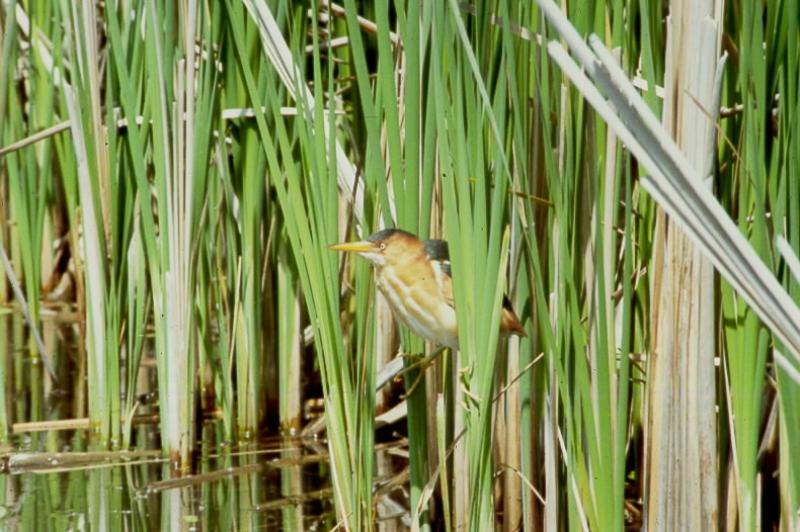
Least Bittern
Sandy Muller, Irene Mazzocchi
- Class
- Aves (Birds)
- Family
- Ardeidae (Herons, Bitterns, and Egrets)
- State Protection
- Threatened
Listed as Threatened by New York State: likely to become Endangered in the foreseeable future. For animals, taking, importation, transportation, or possession is prohibited, except under license or permit. For plants, removal or damage without the consent of the landowner is prohibited.
- Federal Protection
- Migratory Bird Treaty Act
The Migratory Bird Treaty Act implements various treaties and conventions between the U. S. and Canada, Japan, Mexico and the former Soviet Union for the protection of migratory birds. Under this Act, taking, killing, or possessing migratory birds, including nests or eggs, is unlawful unless specifically permitted by other regulations.
- State Conservation Status Rank
- S3B,S1N
Breeding populations Vulnerable in New York - A migratory animal vulnerable to disappearing as a breeder from New York due to rarity or other factors (but not currently imperiled); typically 21 to 80 breeding populations or locations in New York, few individuals, restricted range, few remaining acres (or miles of stream), and/or recent and widespread declines. Nonbreeding (wintering) populations are critically imperiled in New York.
- Global Conservation Status Rank
- G4G5
Apparently or Demonstrably Secure globally - Uncommon to common in the world, but not rare; usually widespread, but may be rare in some parts of its range; possibly some cause for long-term concern due to declines or other factors. More information is needed to assign either G4 or G5.
Summary
Did you know?
When Least Bitterns are alarmed, instead of flying away they often freeze and point their bill upward to blend with the surrounding vegetation.
State Ranking Justification
The first Breeding Bird Atlas (1980-1985) reported 142 blocks and the second Breeding Bird Atlas (2000-2005) reported 129 blocks (Andrle and Carroll 1988 and McGowan and Corwin 2008). It appears that populations have declined by about 9% when comparing the two atlases. One of the most significant threats to this species is loss of appropriate habitat. New York State has lost over half of its wetlands since colonization (Tiner 1984 cited in NatureServe 2003).
Short-term Trends
The first Breeding Bird Atlas (1980-1985) reported a total of 142 blocks with 62 of those blocks as probable or confirmed breeding (Andrle and Carroll 1988). The second Breeding Bird Atlas reported Least Bitterns from a total of 129 blocks. Seventy-two of those blocks were reported as probable and confirmed breeding (Andrle and Caroll 1988 and McGowan and Corwin 2008). A comparison of the two atlases shows a 9% decline in blocks in the state (McGowan and Corwin 2008). Least Bitterns are likely overlooked during breeding bird surveys because they rarely vocalize and so, are often not heard. Least Bittern data from the Breeding Bird Survey (BBS) are too few to assess population trends in New York (Sauer et al. 2007).
Long-term Trends
Historically, Least Bitterns were considered locally common in marshes of the Great Lakes Plain, the Coastal Lowlands, and the Hudson Valley, and possibly breeding in the Champlain Valley (Eaton 1910). In the southern and western portions of the state, Least Bitterns were considered uncommon and local (Bull 1974). Generally, this species is absent from high elevations. It is difficult to determine long term trends.
Conservation and Management
Threats
New York State has lost over half of its wetlands since colonization (Tiner 1984 cited in NatureServe 2003). More recently, losses of wetlands in the Lake Plains portion of the state have been offset as agricultural lands revert back to wetlands, although net losses of wetlands in the Hudson Valley continue. Emergent marshes, which constitute only five percent of the state's 2.5 million acres, have declined overall. Equally important, the quality of remaining habitat is often degraded by fragmentation, exotic plants, and nutrient enrichment (Riexinger, personal communication, October 31, 2003). Run-off from development and agricultural practices may also negatively impact prey. Water level management of Lake Ontario may also change the quality of habitat for Least Bitterns (King 2005). Unnaturally high densities of predators may also pose a threat.
Conservation Strategies and Management Practices
Large wetlands (>12 acres) with abundant emergent vegetation need preservation, protection, and improvement (Gibbs and Melvin 1992). Prevent chemical contamination, siltation, eutrophication, and other forms of pollution in marsh habitats. Control invasive species (such as purple loosestrife) and predators at breeding sites. When managing large wetland complexes for waterfowl, consider retaining areas with cattails and bulrush.
Research Needs
Population distribution, size, and trend studies are needed. Additional studies are needed on the species' breeding biology and movements. Evaluate the effects of invasive species such as common reed and purple loosestrife on breeding populations.
Habitat
Habitat
In New York, Least Bitterns tend to breed in shallow or deep emergent marshes, freshwater tidal marshes (lower Hudson River), or brackish tidal marshes (Long Island). They prefer stands of cattails or bulrush with bur-reed, sedges, or common reed. Stands of cattails are often interspersed with pools of open water or slow-moving channels and some woody vegetation. Large marshes are important breeding areas for this species. Open habitats such as mats of emergent vegetation are rarely used (Frederick et al. 1990 cited in NatureServe 2003).
Associated Ecological Communities
- Brackish tidal marsh
(guide)
A marsh community that occurs where water salinity ranges from 0.5 to 18.0 ppt, and water is less than 2 m (6 ft) deep at high tide. The vegetation in a brackish tidal marsh is dense and dominated by tall grass-like plants.
- Deep emergent marsh
(guide)
A marsh community flooded by waters that are not subject to violent wave action. Water depths can range from 6 in to 6.6 ft (15 cm to 2 m). Water levels may fluctuate seasonally, but the substrate is rarely dry, and there is usually standing water in the fall.
- Freshwater tidal marsh
(guide)
A marsh community that occurs in shallow bays, shoals, and at the mouth of tributaries of large tidal river systems, where the water is usually fresh (salinity less than 0.5 ppt), and less than 2 m (6 ft) deep at high tide. Typically there are two zones in a freshwater tidal marsh: a low-elevation area dominated by short, broadleaf emergents bordering mudflats or open water, and a slightly higher-elevation area dominated by tall grass-like plants.
- Shallow emergent marsh
(guide)
A marsh meadow community that occurs on soils that are permanently saturated and seasonally flooded. This marsh is better drained than a deep emergent marsh; water depths may range from 6 in to 3.3 ft (15 cm to 1 m) during flood stages, but the water level usually drops by mid to late summer and the soil is exposed during an average year.
Associated Species
- American Bittern (Botaurus lentiginosus)
- Marsh Wren (Cistothorus palustris)
- Virginia Rail (Rallus limicola)
Range
New York State Distribution
Least Bitterns are largely restricted to the Lake Ontario and St. Lawrence River plains, and the Lower Hudson River Valley with scattered records from Long Island, Lake Champlain, the Finger Lakes, and the Mohawk Valley. They are generally absent from the Appalachian Highlands and mountainous parts of New York State (Andrle and Carroll 1988, Gibbs and Melvin 1992). On rare occasions birds have been reported mid-winter along the coast.
Global Distribution
The breeding range of the Least Bittern extends from North America to South America. In North America, the breeding range extends from southern Manitoba and north-central United States to southeastern Canada (Ontario and Quebec), eastern Maine, and southern New Brunswick south to western and southern Texas, the Gulf coast, Florida, and Greater Antilles and west to central Montana, Utah (Great Salt Lake, formerly), eastern Colorado, and south-central New Mexico. Least Bitterns also breed in western North America in southern Oregon, interior and southern coastal California, central Baja California, and southern coastal Sonora. In Latin America, breeding Least Bitterns can be found in Guatemala, El Salvador, Honduras, Nicaragua, Costa Rica, Panama, Mexico, and elsewhere. The Least Bittern breeding range extends widely across South America including central Colombia, coastal Peru, and east of the Andes from Venezuela south to northern Argentina and southern Brazil (AOU 1983, Gibbs and Melvin 1992).
Best Places to See
- Lake View Wildlife Management Area (Oswego County)
- Constitution Marsh- New York State Important Bird Area (Putnam County)
- Tonawanda Wildlife Management Area (Niagara, Orleans Counties)
Identification Comments
Identifying Characteristics
Small size, yellow color, and a dark crown are characteristics that distinguish Least Bitterns from all other bitterns and herons (Hancock and Kushlan 1984 cited in Nature Serve 2003). Diagnostic field characteristics include a vivid, greenish-black crown, back, and tail; brownish and white neck, sides, and underparts; and chestnut-colored wings with conspicuous, contrasting, pale-colored wing patches. No other small heron has large buffy patches on the upper side of the otherwise dark wings. Sexes are similar in size, but sexes are dimorphic. Females have a purple-chestnut crown and back and the neck is darkly streaked. Males have a black crown and back. Juveniles are similar to females, but the crown is more brown and paler and the breast and throat are browner and more heavily streaked. Nests are usually built over shallow water 0.3-3.3 ft (0.1-1.0 m) deep (Palmer 1962, Kushlan 1973, Aniskowicz 1981 cited in NatureServe 2003) and tend to be less than 33 ft (10 m) from open water (Weller 1961 cited in NatureServe 2003). A nesting platform with a canopy is made by pulling down and crimping surrounding emergent vegetation, such as cattail or bulrush (Weller 1961 cited in NatureServe 2003). Eggs are elliptical, pale blue or pale green, smooth and non-glossy, averaging 1.2 by 1 in (31 by 24 mm) (Bent 1926, Harrison 1978 cited in NatureServe 2003). The male's advertisement call, most frequently heard in spring, is a dove-like cooing characterized as "uh-uh-uh-uh-uh-oo-oo-oooo-oo-ooah" (Palmer 1962 cited in NatureServe 2003). Females may respond with "ticking" calls (Hancock and Kushlan 1984 cited in NatureServe 2003). When alarmed, three calls may be uttered: a loud, shrieking "quoh," a hissing "hah," or a cackling "tut-tut-tut" (Palmer 1962, Hancock and Kushlan 1984 cited in NatureServe 2003).
Behavior
Least Bitterns spend nearly all their time in dense, grass-like vegetation. During the breeding season, the home range of Least Bitterns varies from 4.5-88.2 acres (1.8-35.7 hectares) with an average of 24 acres (9.7 hectares) in New York (Bogner and Baldassarre 2002).
Diet
The Least Bittern diet consists of small fishes, salamanders, tadpoles, frogs, leeches, slugs, crayfishes, dragonflies, and occasionally shrews and mice.
Best Time to See
Least Bitterns are rarely seen in New York before late April and after September. The best time to see or hear adults is between May and July. This species is often heard and not seen. On rare occasions birds are reported during mid-winter along the coast.
- Active
- Reproducing
The time of year you would expect to find Least Bittern active and reproducing in New York.
Similar Species
- American Bittern (Botaurus lentiginosus)
The American Bittern is much larger and has rich brown underparts set off by black neck streaks.
- Green Heron (Butorides virescens)
The Green Heron is similar in height but wider than the Least Bittern and lacks buff color on the head and wings. Green Herons are often found perched in trees.
Least Bittern Images
Sandy Muller, Irene Mazzocchi
Taxonomy
Least Bittern
Ixobrychus exilis (Gmelin, 1789)
- Kingdom Animalia
- Phylum Craniata
- Class Aves
(Birds)
- Order Pelecaniformes
(Pelicans and Cormorants)
- Family Ardeidae (Herons, Bitterns, and Egrets)
- Order Pelecaniformes
(Pelicans and Cormorants)
- Class Aves
(Birds)
- Phylum Craniata
Additional Resources
References
American Ornithologists' Union (AOU). 1983. Check-list of North American Birds, 6th edition. Allen Press, Inc., Lawrence, Kansas. 877 pp.
Andrle, Robert F. and Janet R. Carroll, editors. 1988. The atlas of breeding birds in New York State. Cornell University Press. 551 pp.
Aniskowicz, B. T. 1981. Behavior of a male least bittern IXOBRYCHUS EXILIS after loss of mate. Wilson Bulletin 93:395-397.
Bent, A. C. 1926. Life histories of North American marsh birds. Bull. U.S. Nat. Mus. 135.
Bogner, Heidi E. and Guy A. Baldassarre. 2002. The effectiveness of call-response surveys for detecting least bitterns. Journal of Wildlife Management. 66(4):976-984.
Brown, M., and J. J. Dinsmore. 1986. Implications of marsh size and isolation for marsh bird management. J. Wildl. Manage. 50:392-397.
Bull, John. 1974. Birds of New York State. Doubleday, Garden City, New York. 655 pp.
Cramp, S. (editor). 1977. Handbook of the Birds of Europe, the Middle East, and North Africa; the Birds of the Western Paleartic. Vol. 1: Ostrich to Ducks. Oxford University Press, Oxford, England. 722 pp.
Eaton, E.H. 1910. Birds of New York. Part 1. New York: University of State of New York. Albany, NY.
Ehrlich, P. R., D. S. Dobkin, and D. Wheye. 1992. Birds in Jeopardy: the Imperiled and Extinct Birds of the United States and Canada, Including Hawaii and Puerto Rico. Stanford University Press, Stanford, California. 259 pp.
Evers, D. C. 1992. A guide to Michigan's endangered wildlife. Univ. Michigan Press, Ann Arbor. viii + 103 pp.
Frederick, P. C., et al. 1990. Relative abundance and habitat preferences of least bitterns (IXOBRYCHUS EXILIS) in the Everglades. Florida Field Nat. 18:1-20.
Gibbs, J.P. and S.M. Melvin. 1992. Least bittern, Ixobrychus exilis. pgs. 71-88 in K.J. Schneider and D.M. Pence, eds. Migratory nongame birds of managment concern in the northeast. United States Department of the Interior, Fish and Wildlife Service, Newton Corner, MA. 400 pp.
Hancock, J., and J. Kushlan. 1984. The Herons Handbook. Croom Helm, Ltd., Kent, England. 288 pp.
Harrison, C. 1978. A Field Guide to the Nests, Eggs and Nestlings of North American Birds. Collins, Cleveland, Ohio.
Jorde, D. G., J. R. Longcore, and P. W. Brown. 1989. Tidal and nontidal wetlands of northern Atlantic states. Pages 1-26 in L. M. Smith, R. L. Pederson, and R. M. Kaminiski (editors). Habitat management for migrating and Wintering waterfowl in North America. Texas Tech. Univ. Press, Lubbock, Texas.
King, Matthew. 2005. Species group report for fresh water marsh nesting birds. Pages 97-106 of Appendix A1, Species group reports for birds in: New York State comprehensive wildlife conservation strategy. New York Department of Environmental Conservation. Albany NY.
Kushlan, J. A. 1973. Least bittern nesting colonially. Auk 90:685-686.
Kushlan, J. A. 1978. Feeding ecology of wading birds. National Audubon Society Res. Rep. 7:249-98.
Levine, E. 1998. Bull's birds of New York State. Comstock Publishing Associates, Ithaca, NY.
McGowan, K.J. and K. Corwin, eds. 2008. The Second Atlas of Breeding Birds in New York State: 2000-2005. Cornell University Press, Ithaca, NY. 688 pp.
McVaugh, W., Jr. 1975. The development of four North American herons (II). Living Bird 14:163-183.
National Geographic Society (NGS). 1983. Field guide to the birds of North America. National Geographic Society, Washington, DC.
NatureServe. 2003. NatureServe Explorer: An online encyclopedia of life [web application]. Version 1.8. NatureServe, Arlington, Virginia. Available http://www.natureserve.org/explorer. (Accessed: January 26, 2004).
New York Natural Heritage Program. 2024. New York Natural Heritage Program Databases. Albany, NY.
Palmer, R. S. (editor). 1962. Handbook of North American birds. Vol. 1. Loons through flamingos. Yale University Press, New Haven. 567 pp.
Payne, R. B., and C. J. Risley. 1976. Systematics and evolutionary relationships among the herons (Ardeidae). Univ. Michigan Mus. Zool., Misc. Publ. No. 150. 115 pp.
Sauer, J.R., J.E. Hines, and J. Fallon. 2007. The North American breeding bird survey, results and analysis 1966-2006. Version 10.13.2007. US Geological Survey, Patuxent Wildlife Research Center, Laurel, MD.
Swift, Bryan L. 1987. An analysis of avian breeding habitats in Hudson River Tidal Marshes. New York State Department of Environmental Conservation, The Hudson River Foundation for Science and Environmental Research, Inc. 62 pp.
Terres, J. K. 1980. The Audubon Society encyclopedia of North American birds. Alfred A. Knopf, New York.
Tiner, R. W., Jr. 1984. Wetlands of the United States: current status and recent trends. U.S. Fish and Wildlife Service, National Wetlands Inventory, Washington, D.C. 59 pp.
Weller, M. W. 1961. Breeding biology of the least bittern. Wilson Bulletin. 73:11-35.
Links
About This Guide
Information for this guide was last updated on: July 1, 2019
Please cite this page as:
New York Natural Heritage Program. 2024.
Online Conservation Guide for
Ixobrychus exilis.
Available from: https://guides.nynhp.org/least-bittern/.
Accessed April 26, 2024.